
The Hove 515m Record: Barnfield on Air, 29.30 Seconds in 2007
 Available in US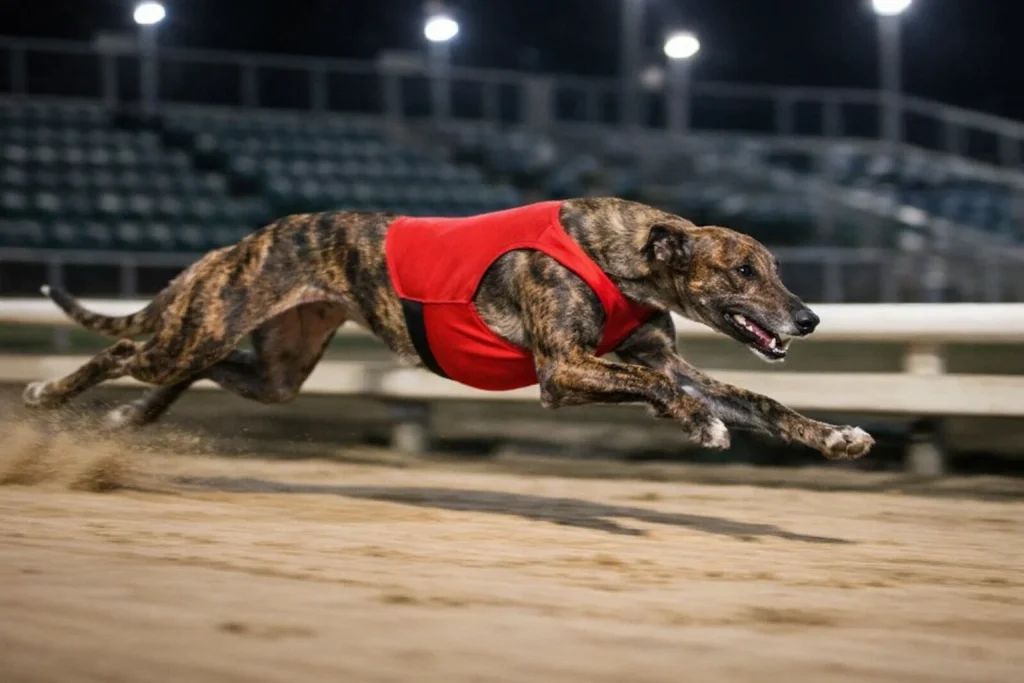
The 29.30s benchmark
Every track in UK greyhound racing has a fastest time that sits in the record book like a ceiling nobody can reach. At Hove, the 515m ceiling is 29.30 seconds, run by Barnfield on Air in 2007 — a time that has stood for nearly two decades and shows no sign of falling. In a sport where hundredths of a second separate winners from losers on any given night, a track record that survives 19 years isn’t just fast. It’s structurally exceptional.
The Hove 515m is the stadium’s flagship distance — the trip that the Coral Regency, the Brighton Belle and most of the high-grade open cards are built around. At 515 metres on a 455-metre circumference, it requires two full bends and a home straight, which means the dog that sets the record has to be fast in the break, efficient through the corners and still accelerating at the line. Barnfield on Air did all three on a single night in 2007.
See also: hove greyhound results — Hove greyhound racing insights.
The dog: Barnfield on Air profile
I’ve gone back through the form records on Barnfield on Air more times than I’d usually admit, because the profile of the dog tells you as much about what it takes to set a track record at Hove as the time itself does.
Barnfield on Air was a middle-distance specialist — a dog whose peak performances clustered at the 480m to 515m range across different UK circuits. The 515m at Hove suited the dog’s running style: a fast break from the box, an economical cornering line through both bends, and a sustained finishing drive that didn’t fade over the final 80 metres. That combination — speed plus efficiency plus stamina — is the profile that the Hove 515m rewards. Dogs with one or two of those qualities run 29.60 or 29.70 and look impressive. Dogs with all three run 29.30 and set records.
The training behind the performance was equally specific. Barnfield on Air was brought to the race in peak condition — the form line in the weeks preceding the record run showed a dog at the top of a carefully managed campaign, with improving times across consecutive outings and no signs of the overtraining or staleness that can blunt a dog’s edge when they’re being pushed too hard. The trainer read the dog’s readiness correctly and entered it at the right moment on the right card.
Conditions on the record-breaking night
Track records don’t happen in isolation from conditions, and one of the reasons I’ve studied the Barnfield on Air run closely is that the night itself is instructive for understanding what Hove requires when a dog runs sub-29.50.
The sand surface at Hove is sensitive to temperature and moisture. On a dry, mild evening with moderate air temperature, the sand firms up and provides better grip — the dog’s paws push off more cleanly and the deceleration through bends is minimised. On a wet or cold evening, the surface softens, grip reduces, and times slow. The record night was, by all available accounts, a dry evening with favourable conditions — not extreme, not artificial, but the kind of night where a top-grade dog running on form would expect to produce a quick time.
Trap draw mattered. The draw Barnfield on Air got for the record race gave the dog a clean angle to the first bend. On a 455m circumference, the 515m start positions the traps in a spot where the run-up to bend one is roughly 80 metres — enough time for a fast breaker to establish a racing line before the field compresses into the turn. A clean first bend, taken at speed, without interference from a rival cutting across or bumping at the apex, is worth tenths. On the record night, the draw and the break combined to give the dog uninterrupted running through the first turn, and the time from that sectional point onward was the product of pure speed on an open track.
Sectional analysis of the record run
Breaking the 29.30 time into its components is where the record becomes properly interesting for form analysis. The first sectional — the split to the first bend — was field-leading by a margin that indicated the dog had won the race in the first five seconds. That early advantage compounded through both bends: no positional interference, no energy spent switching lines, no deceleration from crowding. The mid-race split, through the back straight and second bend, maintained the pace established at the start rather than adding to it. And the final straight — the last 80 metres or so — was run at a pace that would have been competitive in a high-grade race on its own.
What the split pattern tells you. The 29.30 wasn’t set by a dog that burned out of the traps and held on. It was set by a dog that broke fast, ran efficiently and finished strong — a balanced performance across all phases of the race. That’s why the record is so durable. A dog that set a record by going flat out from the box and fading slightly through the finish could be beaten by a more balanced runner having an exceptional night. Barnfield on Air’s record was already the balanced performance, which means beating it requires a dog that is faster at every phase, not just at one.
Hove’s distance portfolio spans seven trips — 285m, 475m, 515m, 695m, 740m, 930m and 970m — but the 515m record carries a specific weight because the trip is the one where all racing attributes matter simultaneously. The 285m record is a speed mark. The 970m record is a stamina mark. The 515m record is both, which is why it tells you more about the absolute quality ceiling at Hove than any other number in the record book.
Why the record has stood
Nineteen years is a long time for any track record to survive, and the question of why 29.30 has endured says something about the structure of UK greyhound racing as much as it does about the time itself.
First, the dog population is smaller. GBGB registered 5,899 new greyhounds in 2023, down 19% since 2019. Fewer dogs means fewer opportunities for the statistical outlier — the one-in-a-thousand dog that combines every attribute at the highest level and arrives at the 515m start on a night when conditions are perfect. The probability of producing a record-breaker falls as the population shrinks.
Check Hove trap statistics for the 515m.
Second, racing patterns have changed. Greyhound racing schedules are denser now — 74 BAGS meetings per week across the UK, five meetings a week at Hove alone — which means dogs race more frequently. A dog racing twice a week has less recovery time between outings than a dog that raced once a week in 2007, and that cumulative load may be marginally reducing peak-night performance across the population. The best dogs are still very fast. They may be very fast slightly less often.
Third, the surface. The Hove sand surface has been maintained, resurfaced and adjusted over the years, and each adjustment — even a small change in sand grade, compaction level or drainage pattern — alters the speed characteristic of the track. The 2007 surface conditions may have been, coincidentally or deliberately, slightly faster than the current surface. Track records are partly a record of the track, not just the dog.
The combined effect: a shrinking dog population running on a marginally different surface at a higher race frequency. None of these factors alone explains 19 years of the record surviving. Together, they make the durability of 29.30 structurally understandable rather than mysterious. The Hove history and records overview places the 515m record within the broader timeline of the stadium’s track records across all seven distances.
