
The Hove Circuit Decoded: All Seven Distances from 285m to 970m
 Available in US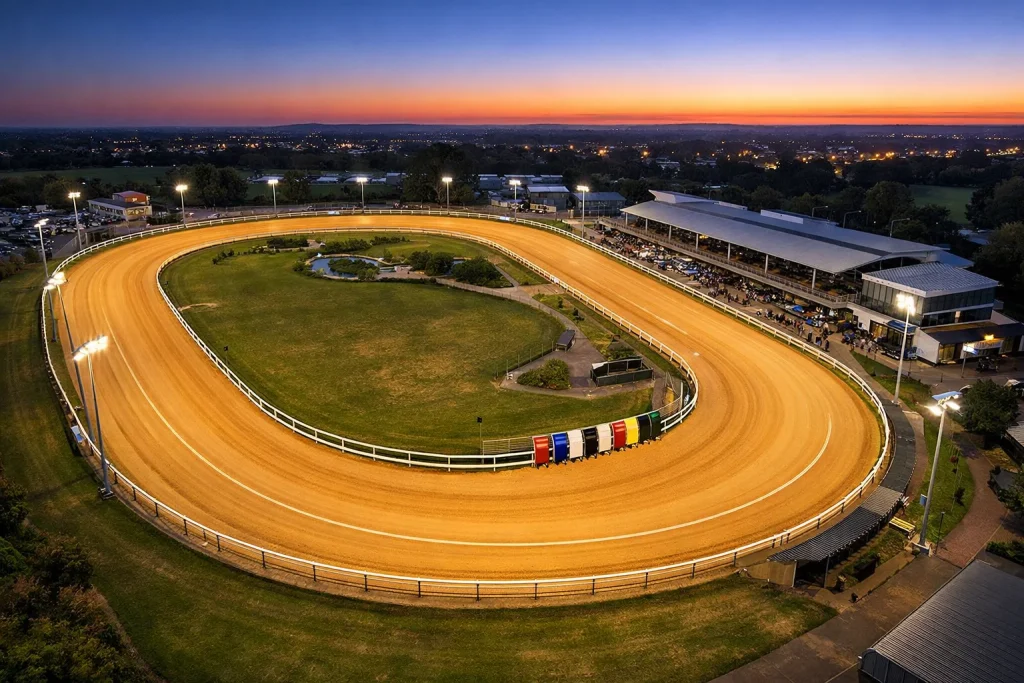
The 455-Metre Circumference and Why It Shapes Form
The first time I tried to compare a 515-metre time from Hove with a 515-metre time from Romford, I thought I was looking at two different sports. The finish times were close, the grade was the same, but the race dynamics bore no resemblance to each other. It took me months to understand why: the circuit underneath the numbers was completely different.
Brighton & Hove Greyhound Stadium sits on a 455-metre circumference — a left-handed sand track with four bends and a specific geometry that dictates how every race unfolds. Seven official distances run here: 285m, 475m, 515m, 695m, 740m, 930m and 970m. That is one of the widest distance menus in British greyhound racing. Most tracks offer four or five distances. Hove offers seven, and each one uses a different section of the circuit, a different trap position, and a different number of bends — which means each distance rewards a different type of dog.
This piece maps the circuit distance by distance. It is not about individual race results — you will not find finishing times or recent winners here. It is about the geometry and physics of the track itself: where the traps sit, how many bends the dogs negotiate, where the run-up starts, and what that means for form analysis. Understanding the circuit is the prerequisite for reading every other piece of data on a Hove racecard.
See also: hove greyhound results — comprehensive Hove greyhound coverage.
The 285m Sprint: Where It Starts, How It Ends
I once watched a 285-metre race at Hove that lasted less than 17 seconds. Seventeen seconds from lid-up to the line. Blink twice and it was over. The sprint distance is the shortest trip at the track, and it demands a completely different athletic profile from everything else on the card.
The 285-metre start position sits partway along the back straight, with the traps angled so that dogs run into a single bend before hitting the home straight and the finish line. There is one turn. One. That means early pace is not just an advantage — it is almost the entire race. A dog that breaks slowly from the traps at 285 metres has no recovery time. By the time it finds its stride, the leader is already rounding the bend and heading for home.
Trap draw takes on an amplified importance here. The inside traps have a marginally shorter path to the bend, but the bend comes so quickly after the start that the run-up distance barely gives the field time to spread. The result is that 285-metre races at Hove tend to be rough, bunched affairs — dogs arriving at the turn in a pack, with early pace and clean running through the bend separating the finishers.
Form analysis at this distance tilts almost entirely toward sectional time. The first-bend split tells you everything. A dog with a consistently fast break will dominate at 285 metres regardless of stamina, weight or late-race speed. This is the sprinter’s distance, and it exists on the Hove card as a specialist trip — not every dog on the roster will ever contest it.
The 475m Intermediate: One Lap of the Circuit
At 475 metres, the dogs complete almost exactly one full lap of the 455-metre circumference, with a short run-in after the fourth bend. It is a distance that sits in the gap between sprint and middle distance — too long for a pure speed dog to blitz through, too short for a stayer to settle into a rhythm.
The 475-metre trip starts further back than the 285-metre position, giving the field a longer run-up to the first bend. That extra run-up changes the dynamic. Dogs have more time to find their stride before the turn, which means the trap draw advantage for inside boxes is slightly diluted compared to the sprint. A dog in trap six with genuine early pace can use the longer run-up to establish position before the first bend, whereas at 285 metres that same dog would be fighting for space immediately.
Four bends make the 475-metre distance a true test of a greyhound’s ability to handle corners. A dog that runs wide through turns loses ground on each one, and four bends means four opportunities to leak distance. Rail-runners gain a cumulative advantage here that is often visible in the finishing margin. I have seen dogs win 475-metre races at Hove by two or three lengths simply because they held the inside line through every bend while wider-running rivals covered an extra ten or fifteen metres over the course of the race.
The 475-metre trip does not appear on every Hove card. It features less frequently than the 515-metre flagship distance, and when it does appear it is often used for specific grading purposes — dogs being assessed between sprint and standard trips, or runners whose recent form suggests they might be better suited to this slightly shorter distance than the full 515 metres.
The 515m Middle Distance: Hove’s Flagship Trip
Every track has a distance that defines it, and at Hove that distance is 515 metres. The majority of graded races on a typical Hove card — afternoon BAGS meetings and evening open races alike — are contested over this trip. It is the distance against which the grading system is calibrated, the distance where the track record stands at 29.30 seconds set by Barnfield on Air in 2007, and the distance that carries the stadium’s four category-one fixtures.
The 515-metre start sits on the home straight, ahead of the main grandstand. Dogs break from the traps, run down the straight, negotiate the first bend, complete a full lap and then run the length of the home straight again to the finish line. Four bends, one complete circuit, plus the home-straight extension. It is a trip that demands a balance of speed, tactical sense and stamina — pure sprinters tend to fade after the third bend, while pure stayers do not break fast enough to be competitive at the first turn.
From a form analysis perspective, 515 metres is the distance where all the racecard columns interact most clearly. Trap draw matters because four bends amplify inside-rail advantage. Sectional time to the first bend matters because the home-straight start gives dogs time to build speed before the turn, meaning the faster breakers establish position early. Weight matters because the distance is long enough for heavier dogs to tire. And grading matters most precisely at this trip, since the A1-to-A9 ladder is primarily built around 515-metre times.
When Hove hosts category-one races — the Coral Regency, Sussex Cup, Brighton Belle and Olympic — all four are contested at 515 metres. The distance is not just the track’s default. It is the track’s identity.
Hove runs five meetings per week, and on a typical card roughly 60 to 70 per cent of the races will be over 515 metres. That concentration means the 515-metre form book at this track is deeper than at most other GBGB venues. More data points, more race-on-race comparisons, more reliable trends. If you are going to specialise in a single distance at Hove, this is the one.
The 695m Staying Trip
Moving beyond 515 metres changes the character of a Hove race entirely. The 695-metre trip covers roughly one and a half laps of the circuit, which means six bends instead of four. Those two extra turns do not simply add distance — they add tactical complexity and a stamina filter that eliminates most middle-distance dogs.
The 695-metre start sits on the back straight, well behind the 515-metre start position. Dogs run through the third and fourth bends, complete a full lap, and then finish down the home straight. The extra distance after the fourth bend means that dogs are running through the home straight twice: once midway through the race, and again at the finish. A dog that leads through the home straight on the first pass is not necessarily the dog that leads on the second.
At this distance, I shift my form analysis away from sectional time to the first bend and toward the dog’s overall pace distribution. A 695-metre runner that clocks a fast first split but fades through the final two bends is not a stayer — it is a middle-distance dog entered at the wrong trip. True staying form at Hove shows a more even pace profile: controlled early speed, maintained through the middle bends, with enough reserve to sustain position in the final straight.
The 695-metre trip appears less frequently on Hove cards than 515 metres but more often than the marathon distances. It occupies a middle ground in the schedule — a regular feature on evening open cards where the racing manager wants variety, and an occasional presence on afternoon BAGS meetings. Dogs that excel at 695 metres tend to be specialists. They are heavier, they run wider through bends to avoid crowding, and they have the aerobic capacity to sustain effort over six turns without fading.
The 740m Marathon Entry Point
The 740-metre distance is where Hove’s card tips into marathon territory. One and a half laps plus an extended run, six bends, and a finishing straight that rewards dogs with genuine endurance rather than tactical speed. Races at this trip appear on selected evening cards and are relatively rare compared to the 515-metre core programme.
What separates 740 metres from 695 metres is not just the extra 45 metres of ground. The start position sits further along the back straight, which gives dogs a longer initial run before the first bend. That longer run-up changes the early-race dynamic: there is more space for the field to sort itself out before the turn, which tends to produce cleaner first-bend passages and fewer incidents of crowding or interference. For dogs that struggle with tight early-race traffic — wide-runners, late developers, or dogs prone to bumping — the 740-metre trip can be a better fit than a shorter staying distance.
Form analysis at 740 metres depends heavily on the dog’s racing history at similar distances. A dog that has never run beyond 515 metres at Hove is an unknown quantity at 740, and the form analyst treats it accordingly. Conversely, a dog with three or four recent 740-metre runs showing consistent finishing times and stable finishing positions is a known entity — the kind of dog that the grading system has correctly placed at this distance. The deeper the form book at a specific distance, the more reliable the analysis.
The 930m and 970m Extreme Trips
The 930-metre and 970-metre trips are Hove’s longest races, covering roughly two full laps of the 455-metre circuit. These are endurance events by greyhound standards — two minutes or more of sustained effort, eight bends, and a tactical landscape that bears almost no resemblance to the sprint or middle-distance races that dominate the card.
At 930 metres, the dogs complete two laps from a start position on the home straight. At 970 metres, the start shifts slightly further along the straight, adding roughly 40 metres of additional ground. The difference between the two trips is subtle but real: the 970-metre start gives a marginally longer run-up, which can affect how the field settles before the first bend. Both distances involve the same number of bends and the same fundamental challenge — maintaining pace through a second full lap after the effort of the first.
These extreme trips are rare on Hove cards. They might appear once or twice on a Saturday evening meeting, and many weeks they do not appear at all. The dog population suited to these distances is small: these are heavy, aerobically efficient animals with the stamina to sustain speed over eight turns. Their sectional times to the first bend are usually slow by 515-metre standards — they are conserving energy for the long haul, and trainers prepare them for endurance rather than explosive pace.
For the form analyst, the extreme distances at Hove present a data problem. Fewer races mean fewer form lines to compare, less reliable grading calibration, and a smaller sample from which to draw trends. I approach these trips with more caution than any other distance on the card. When a 970-metre race appears at Hove, I want to see at least three recent runs at 740 metres or beyond before forming any view on a dog’s chances. Without that staying-distance form, the assessment is guesswork.
Bends, Camber and the Wide-Runner Question
Every discussion about Hove’s distances eventually leads back to the bends. And the bends at Brighton & Hove are where the track’s character is truly defined — not on the straights, where every greyhound runs in a straight line, but on the turns, where geometry separates the winners from the rest.
All turns at Hove go anticlockwise, and the four bends are not identical in radius. The turns at each end of the circuit have slightly different geometries, with the top bends (furthest from the grandstand) being marginally tighter than the bottom bends. That asymmetry matters. A dog that handles the bottom bends smoothly can still lose ground on the tighter top turns, particularly at distances like 695 metres and above where the dog passes through all four bends multiple times.
Camber — the banking of the track surface through the turns — is a design feature that affects how dogs distribute their weight while cornering. At greyhound speeds of up to 40 miles per hour, even a few degrees of camber difference changes the centrifugal force on a dog’s frame. Professor Madeleine Campbell, a veterinary specialist in animal welfare, has described the GBGB welfare strategy as drawing on the expertise of academics, vets and global specialists to ensure the approach to greyhound welfare meets high standards. Circuit design sits within that framework: how bends are banked, how surfaces are maintained, and how run-up distances are calibrated all fall under the regulatory umbrella that GBGB applies to tracks like Hove.
The wide-runner question is central to bend geometry. A wide-running dog takes a longer path through every bend. At 515 metres with four bends, the cumulative extra distance for a dog running two lanes wide is roughly four to six metres — enough to turn a winning margin into a losing one. At 970 metres with eight bends, that figure doubles. Wide-runners can still win at Hove, but they need either superior raw speed or a tactical advantage elsewhere to compensate for the ground they lose on every turn.
Trap Placement and Run-Up Distances
Trap placement is not fixed across all distances at Hove, and understanding where the traps sit for each distance is one of those details that separates a casual observer from someone who actually uses the racecard.
At 515 metres, the traps are positioned on the home straight ahead of the grandstand. The run-up to the first bend is generous — enough for the field to reach near-maximum speed before the turn. At 285 metres, the traps sit on the back straight, closer to the bend, with a shorter run-up that compresses the field and makes the first turn more congested. At 695 metres and above, the traps are positioned on the back straight at various points depending on the exact distance, with the run-up varying accordingly.
The run-up distance — the ground between the traps and the first bend — determines how much time the dogs have to establish their positions before the first turn. A short run-up favours dogs with explosive trap speed: they can reach the bend ahead of the field and claim the rail before anyone else arrives. A long run-up favours dogs with sustained early acceleration rather than a single explosive burst — they build speed gradually and arrive at the bend with momentum rather than from a standing sprint.
I always check which distance a race is using before assessing the trap draw. A dog in trap six at 515 metres has a reasonable run-up to work with. The same dog in trap six at 285 metres has virtually no run-up, and unless it breaks faster than everything else in the race, it will arrive at the bend in traffic. The trap column on the racecard looks the same regardless of distance — six boxes, six colours — but the geometric consequence of each box changes dramatically from one trip to the next.
Hove vs Other UK Tracks: A Circumference Comparison
Hove’s 455-metre circumference places it in the middle of the UK greyhound track spectrum, and that positioning has consequences for how form transfers between venues. Eighteen GBGB-licensed stadiums were active in Britain as of early 2026, and each has its own circumference, bend geometry and surface characteristics.
Romford’s circuit is roughly 400 metres — smaller, tighter, with sharper bends that penalise wide-runners more aggressively than Hove’s slightly broader turns. A dog transferring from Romford to Hove for the first time often improves simply because the wider circuit gives it more room through the bends. Conversely, Monmore Green runs on a 480-metre circumference, larger than Hove, with gentler bends and longer straights. Dogs moving from Monmore to Hove sometimes struggle with the tighter turns.
Towcester, before its closure, ran on one of the largest circuits in the country — a track where stayers thrived and sprinters were irrelevant. Sunderland’s circuit is compact, comparable to Romford, producing fast short-distance times but penalising dogs that need space to run wide. Each track’s circumference creates a microclimate of form: what works at one track does not automatically work at another.
For the form analyst at Hove, this comparison matters most when a dog appears on the card with recent form from another track. If its last three runs were at Romford, the finishing times will have been produced on a 400-metre circuit. Those times are not directly transferable to Hove’s 455-metre loop. A dog that ran 29.80 at 515 metres equivalent at a smaller track might run 30.10 at Hove — not because it has slowed down, but because the circuit geometry is different. The reverse applies when a Hove regular travels to a tighter track: it may look slower on paper while running the same race.
This is why grading is track-specific. An A3 at Hove and an A3 at Romford represent different time bands. The racing manager at each venue calibrates the grading ladder to the local circuit, which means the grade column on a Hove card is meaningful at Hove and nowhere else. When I assess a dog with mixed-venue form, I discount the away runs and weight the Hove runs more heavily. Home-track form is always the most reliable indicator.
How to Use Distance Data When Reading a Card
Distance data is not a standalone piece of analysis — it is the lens through which every other piece of racecard data should be read. And that principle applies every time you pick up a Hove card, whether it is a Wednesday afternoon BAGS meeting or a Saturday evening open.
Explore the 285m sprint distance at Hove.
When I sit down with a Hove racecard, the distance is the first thing I check for each race. Before trap draw, before weight, before the form line. The distance tells me which type of dog this race rewards, which running styles will be advantageous, how many bends the field will negotiate, and whether the trap draw is a major factor or a minor one. All of those assessments flow from the distance, and they change every time the distance changes.
A practical example: a dog with a form line of 1-1-2-3 at 515 metres is entered on tonight’s card at 695 metres for the first time. The form line looks strong, but the distance change renders it unreliable. The dog has never faced six bends. It has never sustained pace beyond the four-bend 515-metre trip. Its sectional times at 515 metres — fast early, steady late — might not hold over the extra 180 metres. The distance change is the critical variable, and the racecard’s other columns cannot compensate for that uncertainty.
Equally, a dog with moderate 515-metre form — form line of 4-3-5-4 — that switches down to 285 metres might suddenly look competitive. If its sectional times show a consistently fast first-bend split, that early speed becomes the dominant factor at the sprint distance, even though the finishing positions at 515 metres were ordinary. The distance change reframes the dog’s profile, and the form analyst who reads the card through the distance lens spots the opportunity that the casual reader misses.
Hove’s seven-distance menu makes this kind of analysis richer than at most tracks. The range from 285 metres to 970 metres covers the full spectrum of greyhound racing, from pure-speed sprints to endurance marathons. Every dog on the roster has a best distance, a worst distance, and a range of trips where it can compete. Mapping that range is the form analyst’s job, and the circuit geometry is where the map begins.
