
A Century at Brighton & Hove: The Stadium's History and Standing Records
 Available in US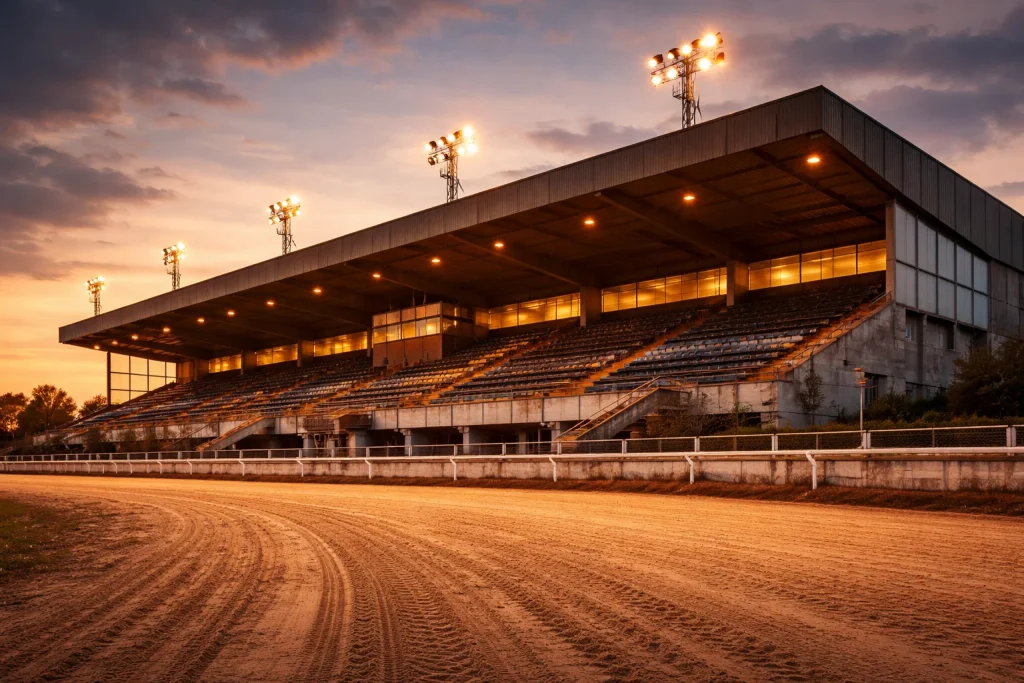
1928 Origin and Why Hove’s History Is Different
Most tracks in British greyhound racing carry their history lightly — a plaque in the lobby, a paragraph on the website, maybe a faded photograph behind the bar. Hove is different. The history at Brighton & Hove Greyhound Stadium is not background. It is part of the track’s competitive identity, woven into the names on the racecard, the records on the board and the annual fixtures that draw crowds well beyond the regular Thursday evening audience.
The stadium opened on 2 June 1928, which places it among the earliest purpose-built greyhound tracks in Britain. It predates the majority of GBGB-licensed venues still operating today and has outlasted dozens that opened in the boom years of the 1930s and 1940s. That longevity is not accidental. Hove survived the post-war decline, the television era, the betting-shop revolution and the digital migration of its audience. It survived because it adapted, and because the people who ran it — trainers, administrators, racing managers — treated the track as a living institution rather than a fixed asset.
This piece covers the stadium’s history from that 1928 opening to the present day, with particular attention to the records, figures and events that shaped the track’s identity. It is not a nostalgic tour. It is a factual chronology built from the data that the track has generated over nearly a century of continuous racing.
See also: hove greyhound results — your Hove greyhound racing reference.
2 June 1928: The First Hove Stakes
I have read every account I can find of the first meeting at Brighton & Hove, and the detail that stays with me is the crowd. Nearly 7,000 spectators turned up on 2 June 1928 to watch the inaugural Hove Stakes. Seven thousand people, at a sport that had only arrived in Britain two years earlier, at a track that had been a construction site weeks before.
The context matters. Commercial greyhound racing came to Britain in 1926, with the first licensed meeting held at Belle Vue in Manchester on 24 July of that year. By 1928, tracks were opening across the country at a pace that reflected genuine public enthusiasm. Hove was part of that wave — not the first, but early enough to claim founding-generation status. The stadium was purpose-built on Nevill Road in the Hove district of Brighton, designed as a dedicated greyhound racing venue with a sand track, covered stands and facilities that were modern for the era.
The Hove Stakes — the first race at the new stadium — was an open event that set the template for the track’s competitive programme. From the very beginning, Brighton & Hove positioned itself as a racing venue, not a novelty attraction. The quality of the card on that opening night, the size of the crowd and the infrastructure of the stadium all signalled that this was a track built to last. Nearly a century later, that signal has been vindicated.
What the 1928 opening did not anticipate was the scale of the boom that followed. In 1946, greyhound racing in Britain attracted an estimated 75 million spectators across what would peak at 77 licensed tracks in January 1947. Hove was a beneficiary of that boom, establishing its place in the southern racing circuit during the years when the sport’s audience rivalled football and cinema as a mass entertainment. The decline that followed — gradual, irreversible, driven by television and changing leisure habits — reduced those 77 tracks to the 18 that remain licensed under GBGB as of early 2026. Hove is one of the 18. Most of its contemporaries from 1928 are not.
Royal Visit 1962: HRH Queen Elizabeth II
Royal patronage confers a particular kind of status in British sporting culture, and Brighton & Hove received it in 1962 when HRH Queen Elizabeth II visited the stadium. The visit placed Hove in a category of sporting venues recognised at the highest level of public life — an acknowledgement that greyhound racing, at its mid-century peak, was considered a legitimate and significant national sport.
The details of the visit are sparsely documented in the public record, which is typical for royal engagements of that era. What is known is that the Queen attended a race meeting at the Nevill Road stadium, that the event was treated as a formal occasion by the track’s management, and that the visit was reported in the local and national press. For a track that had been operating for 34 years at that point, the royal visit served as a validation of its standing — not just as a commercial venue but as part of the fabric of British sporting life.
Sixty-four years later, the sporting landscape has changed beyond recognition. The 77 tracks of the 1947 peak have contracted to 18. Public attitudes toward animal sports have shifted. The political environment — particularly after the Welsh and Scottish ban votes of March 2026 — is more hostile than at any point in the sport’s history. The royal visit of 1962 belongs to a different era, but it remains part of Hove’s institutional memory and part of the case that the stadium’s supporters make for the track’s historical significance.
George Curtis and the Kennel Era
Every track has a defining trainer, and at Hove that figure is George Curtis. His name appears in every significant chapter of the stadium’s mid-to-late twentieth century history, and his kennel produced the dog that gave Brighton & Hove its most famous moment.
Curtis was a Hove-based trainer whose operation dominated the track’s competitive programme for decades. His methods were rooted in a philosophy that valued consistency over spectacle: meticulous feeding regimes, careful distance selection, and a training schedule that prioritised the long-term health of his dogs over short-term results. That approach was unusual in an era when many trainers ran dogs as frequently as the card allowed, and it paid dividends in the longevity and reliability of Curtis’s racing string.
The kennel era — the period when a single dominant trainer could shape the identity of an entire track — is not something you see much in modern British greyhound racing. Today, the trainer population at Hove is more distributed, with multiple kennels competing for card places and category-one entries. But in Curtis’s time, the concentration of quality in one operation was remarkable. His dogs filled the top grades at Hove with such regularity that the track’s competitive identity became inseparable from his kennel’s output.
Curtis’s legacy extends beyond his own training career. The dogs he bred and the methods he established influenced the next generation of Hove trainers, creating a lineage that connects the mid-century kennel era to the modern training operations that dominate the track’s cards today. His most lasting legacy, however, is not a method or a bloodline. It is a single dog, and a single record, that turned Brighton & Hove from a well-regarded regional track into a landmark of British greyhound racing history.
Ballyregan Bob: 32 Straight Wins, 9 December 1986
On the evening of 9 December 1986, a brindle dog named Ballyregan Bob crossed the finish line at Brighton & Hove Greyhound Stadium and entered the record books. It was his 32nd consecutive victory — a world record that has never been equalled or surpassed in the decades since.
The record-breaking run began in early 1985 and extended across 32 races at multiple tracks, with the majority of victories coming at Hove under the training of George Curtis. The sequence was not a streak of narrow wins against weak opposition. Ballyregan Bob was the dominant greyhound of his generation, running times that consistently outpaced the fields he faced. His victories at Hove were produced on the stadium’s sand surface at 515 metres — the track’s flagship distance — and they drew crowds that had not been seen at the venue since the post-war boom years.
The 32nd win at Hove was a national event. Television cameras were present. The crowd was the largest the stadium had hosted in years. The atmosphere, according to those who were there, was unlike anything greyhound racing typically produced — more akin to a cup final than a regular evening card. Ballyregan Bob did what great athletes do: he made people who did not normally follow the sport pay attention.
For Hove, the Ballyregan Bob legacy is permanent. The stadium hosts an annual Ballyregan Bob Memorial card — a commemorative fixture that keeps the dog’s name in the racing calendar. The record of 32 consecutive wins is cited in every history of British greyhound racing, and Hove’s association with that record gives the stadium a historical claim that no other active GBGB track can match. Dogs have won long sequences since 1986, but none has reached 32. The number stands alone.
George Curtis, the man who trained Ballyregan Bob, became synonymous with the achievement. His kennel methods — patient conditioning, careful race selection, meticulous attention to the dog’s physical state — were vindicated in the most public way possible. The record was not just a dog’s achievement. It was a trainer’s, and it was a track’s.
The 1987 Surface Change and Its Record Impact
The year after Ballyregan Bob’s record, Brighton & Hove undertook a significant change to the racing surface. The 1987 surface upgrade altered the composition of the sand track, affecting going conditions, drainage characteristics and — critically — the times that dogs could achieve.
Surface changes at greyhound tracks are not cosmetic. The composition of the sand, the depth of the base layer, the camber through bends and the drainage profile all affect how fast dogs can run and how safely they can negotiate turns. A harder surface produces faster times but increases the impact on joints. A softer surface absorbs more energy, slowing times but potentially reducing injury risk. The balance between speed and safety is a design decision that every track faces, and Hove’s 1987 change recalibrated that balance.
The impact on the record book was immediate. Times set before the surface change became historical benchmarks rather than active targets. The new surface produced a different set of finishing times, and the grading system had to recalibrate to reflect the altered conditions. Records set on the old surface — including many from the Ballyregan Bob era — became pre-change marks that would never be approached on the new ground.
This is why comparing historical times at Hove requires a surface disclaimer. A 29-second 515-metre time on the pre-1987 surface is not the same as a 29-second time on the post-1987 surface. The track is the same shape, the distance is the same, but the ground beneath the dogs’ feet changed, and with it, the meaning of every time recorded since.
Barnfield on Air, 29.30s: The 515m Record Since 2007
The current 515-metre track record at Hove — 29.30 seconds, set by Barnfield on Air in 2007 — has stood for nearly two decades. In greyhound racing, where dogs race multiple times per week and hundreds of races are run at the flagship distance each year, a record that lasts 19 years is extraordinary.
Barnfield on Air’s 29.30 was not set during a category-one final or a showcase event. It was produced in standard racing conditions at Brighton & Hove, on the post-1987 surface, in a field that was competitive but not exceptional. The time reflected everything working perfectly: a clean break from the traps, an unobstructed first bend, a strong rail position through the middle of the race, and a finish-line burst that shaved fractions from what was already an exceptional run.
Since 2007, A1-grade dogs at Hove have routinely clocked times in the 29.50 to 29.80 range — fast, competitive, but consistently short of the record. The gap between regular elite performance and the record mark is roughly two-tenths of a second, which translates to approximately two lengths at greyhound racing speeds. That margin is both small and enormous: small because a single clean run on a fast night could conceivably close it, enormous because no dog has managed it in 19 years of trying.
For the form analyst, the 515-metre record serves as a ceiling against which all other times are measured. When a dog on a Hove racecard shows a recent time of 29.60, the analyst knows that the dog is operating at a level roughly three-tenths slower than the fastest time the track has ever produced. That context — how close to the ceiling, how consistent across multiple runs — is part of the grading assessment and part of the tactical picture that the racecard reveals.
Successor Trainers: Bob Young, Brian Clemenson, Seamus Cahill
After George Curtis, the mantle of leading Hove trainer passed through a succession of figures who each left their mark on the track’s competitive programme. Bob Young, Brian Clemenson and Seamus Cahill represent three distinct eras in the stadium’s training lineage, and each brought a different approach to the business of preparing dogs for Brighton & Hove’s circuit.
Bob Young bridged the gap between the Curtis era and the modern period. His kennel operated at Hove during the years when the track was adjusting to the post-1987 surface change and the broader contraction of the UK greyhound industry. Young’s dogs were consistent graded performers — reliable A2 and A3 runners who filled the upper grades at Hove without necessarily dominating the category-one programme the way Curtis’s operation had.
Brian Clemenson brought a more commercially oriented approach. His kennel’s presence on Hove cards was notable for the breadth of his entries — dogs across multiple grades and distances, with a training philosophy that emphasised volume and variety. Clemenson runners were a fixture on both afternoon BAGS cards and evening open meetings, and his operation contributed significantly to the depth of fields at a time when some tracks were struggling to fill cards.
Seamus Cahill represents the current era. His Hove-based kennel is a regular presence on the track’s racecards, with runners that tend to share identifiable characteristics: stable weight, strong first-bend sectionals, and a preference for the 515-metre standard trip. Cahill’s training methods reflect the modern regulatory environment — GBGB’s welfare strategy, the increased kennel inspection regime, the data-driven approach to conditioning — and his category-one entries at Hove have been competitive in recent seasons.
The succession from Curtis through Young, Clemenson and Cahill is not just a list of names. It represents the evolution of greyhound training at a single track across five decades — from the kennel era of concentrated dominance to the distributed, regulated, data-informed environment that characterises modern GBGB racing. Each trainer responded to the conditions of their time, and together they form a thread that connects the Ballyregan Bob era to tonight’s racecard.
Track-Record History Across All Distances
The 515-metre record gets the attention, but Hove holds track records across all seven of its racing distances, and each one tells a story about the type of dog and the type of race that produced it.
Hove’s distance portfolio — 285m, 475m, 515m, 695m, 740m, 930m and 970m — spans the full spectrum from pure sprint to extreme marathon. The records at each distance reflect the different demands of each trip. The 285-metre record belongs to a sprinter — a dog with explosive trap speed and the ability to negotiate a single bend at maximum velocity. The 970-metre record belongs to a stayer — a dog whose aerobic capacity and bend-handling over eight turns allowed it to sustain pace across two full laps of the 455-metre circumference.
Track records at the shorter distances tend to be more volatile. Sprint races are influenced heavily by going conditions — a fast surface on a dry evening can produce times that would be unachievable on a rain-softened track the following week. The longer-distance records are more stable because the extended race duration averages out momentary conditions. A 970-metre race takes two minutes or more, and no single surface condition can sustain an advantage for that long.
The greyhound-data.com database maintains a historical record of best times at Hove across all distances, and it serves as the reference point for anyone tracking record attempts. Most of the current records were set in the post-1987 surface era, making them directly comparable to contemporary form. Pre-1987 records, set on the old surface, are historical curiosities rather than active benchmarks — fast in their time, but produced on different ground.
For the form analyst, the distance-specific records provide a scaling framework. If the 515-metre record is 29.30 and a dog on tonight’s card has a recent best of 30.20, the analyst knows the dog is operating roughly 90 hundredths off the all-time pace. At 695 metres, a different record sets a different ceiling, and the gap between a dog’s recent form and that ceiling tells a different story about quality and potential. Every distance has its own scale, and the records define the top of each one.
The Centenary Horizon: 2026 UK, 2028 Hove
Two centenary markers frame the next phase of Hove’s history: the UK-wide centenary of greyhound racing in 2026, and Brighton & Hove’s own stadium centenary in 2028.
The UK centenary marks 100 years since the first licensed greyhound meeting at Belle Vue, Manchester, on 24 July 1926. That event launched commercial greyhound racing in Britain, and the centenary year has become a focal point for the sport’s supporters and its critics alike. In 1946, the sport drew 75 million spectators. In 2026, the number of online betting accounts in the UK has grown from 17 million in 2014 to over 37 million — but the audience at the track has contracted to a fraction of its peak, and the number of licensed venues has fallen from 77 to 18.
Read about Ballyregan Bob’s 32 consecutive wins at Hove.
Hove’s own centenary arrives in 2028, two years after the national milestone. The stadium will be one of the oldest continuously operating greyhound tracks in the world if it reaches that date — a distinction that carries historical weight regardless of one’s view on the future of the sport. The track has survived the post-war contraction, the betting-shop revolution, the digital migration of its audience, and the political pressure of the 2026 Welsh and Scottish bans. Whether it survives to celebrate 100 years depends on factors that extend well beyond the Nevill Road gates.
Jeremy Cooper, former Chair of GBGB and former Chief Executive of the RSPCA, has characterised the political attacks on greyhound racing as tactics driven more by extremism than by genuine welfare concern — motivated by fundraising and support at one end of the animal rights movement rather than by the welfare of the dogs. That view sits at one pole of the debate. At the other pole are the Welsh and Scottish legislatures, which voted to end racing entirely. Hove exists between those poles: a regulated, licensed venue operating in an English legal environment that still permits racing, while the political ground shifts beneath it.
The centenary horizon is not a celebration or a warning. It is a timestamp. Brighton & Hove Greyhound Stadium has been generating race data, training champions and serving an audience for nearly 100 years. The record book — from the 7,000 spectators at the 1928 Hove Stakes to Ballyregan Bob’s 32 consecutive wins to Barnfield on Air’s 29.30 seconds — is the track’s testimony. What happens in the next century is a question that the data alone cannot answer.
