
Hove's Category One Races: The Four Fixtures That Define the Stadium
 Available in US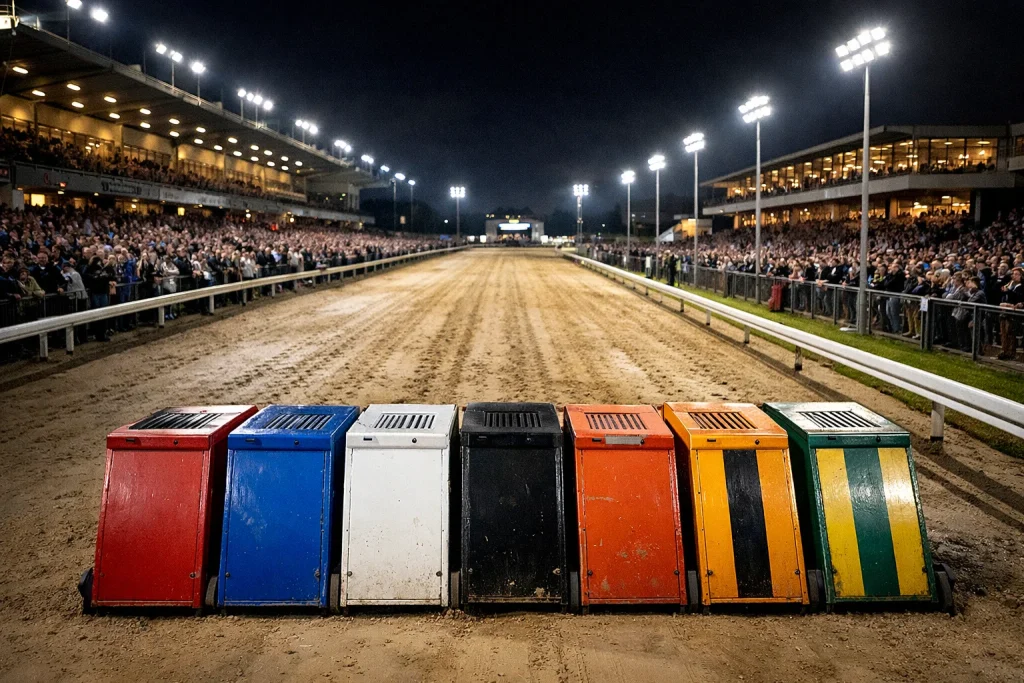
What Category One Status Means at GBGB
I remember the first Coral Regency final I attended at Hove — the atmosphere felt like a different sport from the Thursday evening graded cards I had been studying for months. The crowd was larger, the floodlights seemed brighter, and the dogs in the traps were a class above anything I had seen on a regular A1 race. It took me a while to understand what made that night different, and the answer was not just quality. It was status.
GBGB classifies its open races into three tiers: Category One, Category Two and Category Three. The classification determines the minimum prize fund, the level of regulatory oversight, the calibre of entry and — perhaps most importantly — the prestige attached to the event. A Category One race is the highest tier. It is GBGB’s equivalent of a Group One in horse racing: a flagship event that defines the track hosting it and shapes the racing calendar for the entire year.
Brighton & Hove holds four Category One fixtures: the Coral Regency, the Sussex Cup, the Coral Brighton Belle and the Olympic. Four races across the calendar, each contested at 515 metres, each carrying its own identity and history. Together they form the backbone of Hove’s competitive programme. This piece takes each one in turn — origin, format, prize fund, profile — and then steps back to look at the economics, calendar placement and trainer dynamics that surround the category-one programme as a whole.
See also: hove greyhound results — all Hove greyhound results and analysis.
Coral Regency: The Twenty-Thousand-Pound Classic Since 1948
The Coral Regency is the race that put Hove on the national greyhound map, and it carries the kind of weight that no amount of regular graded racing can replicate. I have covered this event for most of my nine years at the track, and the thing that strikes me every time is the depth of the field. Dogs that win the Regency do not stumble into it — they are targeted at it months in advance by trainers who know what the race demands.
The numbers tell a clear story. The Coral Regency carries a prize fund of £20,000 and has been staged at Brighton & Hove since 1948. That makes it one of the longest-running category-one fixtures in British greyhound racing — older than several of the tracks that currently host similar events. The distance is 515 metres, Hove’s flagship trip, and the race is open to all greyhounds meeting the entry criteria. There is no sex restriction, no age cap beyond normal racing eligibility, and no geographical limitation on entries. Dogs from any GBGB-licensed kennel in Britain can be entered.
The format follows the standard GBGB open-race structure: preliminary rounds, semi-finals and a final. The preliminary heats are typically run over two or three weeks, with the fastest qualifiers advancing to semi-final night. The final itself is a single six-runner race, and it is the centrepiece of one of Hove’s biggest evenings of the year. Prize money is distributed across the rounds, but the bulk goes to the final — the winner taking the largest single-race purse available at the stadium.
Coral’s sponsorship of the Regency ties the race into the broader commercial structure of British greyhound racing, where bookmaker and media partnerships provide the financial foundation for category-one events. The sponsorship does not alter the race’s competitive format or entry criteria — those are set by GBGB — but it funds the prize pot and brings the race to a wider audience through broadcast and marketing channels.
From a form analyst’s perspective, the Regency is the race where Hove’s regular graded form meets elite open-race competition. Dogs that have been dominant at A1 on the Thursday night card suddenly face opponents from other tracks — dogs graded at their home venues, running on Hove’s 455-metre circuit for perhaps the first time. That collision between home-track form and away form makes the Regency one of the hardest races to assess and one of the most revealing.
Sussex Cup: The Regional Flag Fixture
If the Coral Regency is Hove’s national statement, the Sussex Cup is its regional anchor. The name itself ties the race to the county, and in the ecology of British greyhound racing — where stadiums compete for entries, sponsors and public attention — that local identity carries genuine value.
The Sussex Cup runs at 515 metres, matching the Regency distance, and holds Category One status under GBGB classification. Its format mirrors the standard open-race progression: heats, semi-finals, final. The prize fund sits below the Regency’s £20,000 but remains substantial enough to attract quality entries from across the licensed-trainer network.
What makes the Sussex Cup distinct is its position in the Hove calendar. While the Regency is the stadium’s headline fixture — the one that draws national attention and the strongest travelling entries — the Sussex Cup occupies a different slot in the racing year. That separation is deliberate. GBGB’s calendar committee works to ensure that category-one races at the same venue do not cluster together, which would split the available talent pool and weaken individual fields. The Sussex Cup sits in its own window, drawing entries that might not have been aimed at the Regency and giving trainers a second major target at Hove.
I find the Sussex Cup particularly interesting from an analytical standpoint because it tends to produce different types of winners from the Regency. The Regency, as the higher-profile event, attracts the very best dogs from across the country — fast, proven, battle-hardened open-race performers. The Sussex Cup, while still Category One, sometimes draws a slightly broader entry that includes improving younger dogs and dogs stepping up from Category Two level. That difference in field composition changes the form dynamics and can produce less predictable results.
Coral Brighton Belle: Ten-Thousand-Pound Bitches-Only 515m
The Coral Brighton Belle occupies a unique slot in British greyhound racing: it is one of very few category-one fixtures restricted to bitches. That restriction is not cosmetic. It produces a different race from the open events, with different field dynamics, different form patterns, and different analytical challenges.
The Brighton Belle was elevated to Category One status in 2023 with a prize fund of £10,000 for the bitches-only final over 515 metres. Before 2023, the race existed at a lower classification. The promotion to Category One reflected both the quality of the fields it had been attracting and GBGB’s decision to strengthen the category-one calendar at Hove as part of the stadium’s competitive portfolio.
Bitches-only races change the form calculus in specific ways. The weight range narrows — bitches typically weigh less than dogs, and the lighter, more uniform field affects how the race unfolds through bends. Lighter dogs often handle Hove’s turns with more agility, which can reduce the usual inside-trap advantage. The pace profile can also differ: bitches tend to show slightly different sectional-time distributions at 515 metres, with many showing strong early pace relative to their weight.
Coral’s sponsorship of the Brighton Belle — as with the Regency — provides the commercial backing that supports the prize fund. The £10,000 figure places the Belle below the Regency’s £20,000 but above most Category Two events at the track. For trainers with quality bitches in their kennel, the Belle is a targeted objective. Dogs are prepared specifically for this race, with trial runs at Hove in the weeks leading up to the heats to acclimatise them to the circuit if they have been racing elsewhere.
The elevation to Category One has raised the quality of entries noticeably. Before 2023, the race attracted strong regional fields. Since the reclassification, it draws from a wider geographical spread, with leading kennels across Britain entering their best bitches. The result has been deeper, more competitive heats and finals that genuinely test the best female greyhounds in the country at Hove’s flagship distance.
The Olympic: An Older Stake with a Hove Identity
The Olympic is the quietest of Hove’s four category-one fixtures, and I mean that as a compliment. It does not carry the prestige of the Regency or the distinctiveness of the Belle. It is simply a solid, long-established race that has been part of the Hove programme for decades, and it anchors the stadium’s category-one calendar by providing a fourth elite event spread across the racing year.
Contested at 515 metres under standard Category One conditions, the Olympic follows the same heat-to-final format as the other three fixtures. Its prize fund sits in line with the Sussex Cup, making it a significant target for trainers without reaching the headline figures of the Regency. The race’s identity comes not from its purse but from its longevity — it has been a feature of the Hove calendar for long enough that certain training operations regard it as a staple rather than a special occasion.
For the form analyst, the Olympic often produces the most competitive fields of the four category-one races at Hove. The Regency attracts the very best and can produce one-sided finals. The Belle is restricted by the bitches-only condition, which limits the pool. The Sussex Cup sits in its own calendar window. The Olympic, by contrast, tends to fall at a point in the year when a broad population of dogs is in peak racing condition, which means the heats are deeper and the semi-final cut is harder to predict.
I have found that the Olympic is also the race where home-track form is most predictive. Because it sits later in the year than the Regency, many of the entries have already run at Hove in the preceding months — some in graded races, some in Category Two events, some in the earlier category-one rounds. That accumulated Hove form gives the analyst a richer dataset to work with than for the Regency, where many entries arrive from other venues with limited Brighton & Hove track experience.
Prize Fund Economics: Where Category One Money Comes From
Prize money in British greyhound racing does not materialise from thin air, and understanding where it comes from explains a great deal about the pressures facing category-one events at Hove and every other GBGB track.
The primary funding source is the British Greyhound Racing Fund, which collected £6.75 million in voluntary bookmaker contributions during 2024-25 at a rate of 0.6 per cent of greyhound-related turnover. That levy funds prize money, welfare programmes and regulatory infrastructure across all licensed tracks. Total prize money across British greyhound racing stands at £15,737,122 annually — a figure that covers everything from the English Greyhound Derby’s £175,000 winner’s purse down to the smallest graded race at the smallest track.
Category-one races at Hove draw from this pool, supplemented by sponsorship income from partners like Coral. The Regency’s £20,000 prize fund and the Belle’s £10,000 are funded through a combination of BGRF allocation, track contribution and sponsor support. Without any one of those three pillars, the prize funds would shrink — and smaller prize funds mean weaker fields, which means less public interest, which means less sponsorship income. The cycle is self-reinforcing in both directions.
Mark Moisley, GBGB’s Commercial Director, has been direct about the financial pressures. Bookmaker revenue, he has noted, has been declining year on year for some time, and if the trend continues at its current pace, the sport will face serious issues. That candour matters for anyone trying to understand why category-one prize funds at Hove have not grown in line with inflation, and why the commercial partnerships that underpin these races carry more weight than they might appear to from the outside.
The economics of category-one racing are not abstract. They determine whether Hove can attract the quality of entries that justify Category One status in the first place. A race with a declining prize fund eventually loses its pull on the best kennels. When the best kennels stop entering, the race loses its competitive edge. When it loses competitive edge, the sponsor asks harder questions. The prize fund is not just money — it is the gravitational force that holds the category-one programme together.
Category One vs Category Two at Hove
The distinction between Category One and Category Two at Hove is not just a ranking label. It determines the regulatory requirements, minimum prize fund thresholds, entry criteria and the level of GBGB oversight that the race receives.
A Category One race at Hove must meet GBGB’s top-tier requirements: minimum prize fund, nationally open entry criteria, a specified format of heats and final, and veterinary oversight at a level beyond what graded racing requires. Category Two races carry lower minimum prize funds, may restrict entries geographically, and operate under a lighter regulatory framework. Hove hosts both — the four Category One fixtures described above, plus a number of Category Two open races that fill out the competitive calendar throughout the year.
For the form analyst, the practical difference between the categories is field quality. A Category One final at Hove will typically feature six dogs that would be competitive at A1 grade or above — dogs whose recent form lines show winning or placing in open-race competition across multiple tracks. A Category Two final might include dogs that are strong at A1 in graded company but have not yet proven themselves in elite open-race fields. The step up from Category Two to Category One is real, and not every dog makes it.
There is also a calendar implication. Category One races anchor the schedule. The racing manager at Hove builds the annual card around the four category-one dates, then slots Category Two events into the gaps. Trainers target the Category One fixtures first and treat Category Two races as either preparation runs or consolation targets for dogs that did not qualify for the bigger events. Understanding this hierarchy helps the analyst read the form line in context: a dog that finished third in a Category One semi-final is a different proposition from one that won a Category Two heat, even if the raw finishing times are similar.
Calendar Placement and Finals Night
Spacing matters. Hove’s five meetings per week — Wednesday and Sunday afternoons, Friday morning, Thursday and Saturday evenings — create a dense fixture list, and the four category-one races need to sit within that schedule without cannibalising each other’s entries or overwhelming the regular graded programme.
GBGB’s calendar committee coordinates category-one dates across all licensed tracks nationally, ensuring that major races at different venues do not clash on the same evening. Within Hove’s own calendar, the four fixtures are spread across the year with roughly three-month gaps between them. This spacing serves several purposes: it allows trainers to campaign the same dog across multiple category-one events at Hove without burnout, it gives the track’s graded programme time to run uninterrupted between major races, and it distributes the commercial and media attention across the year rather than concentrating it into a single period.
The culmination of the category-one calendar at Hove is finals night — a card where the final of one or more category-one races takes place alongside the best of the graded programme. Finals night is the biggest evening in the Hove calendar. The card is deeper, the crowd is larger, and the atmosphere is markedly different from a regular Thursday or Saturday meeting. From a form perspective, finals night is also unique because the dogs in the category-one final have already been through two or three rounds at Hove — their recent form at this specific track is deep and reliable, making the final one of the most data-rich races of the year to analyse.
Recent Winners and Trainer Concentration
Look at the winners of Hove’s category-one races over the past five years and a pattern emerges: the same kennel names appear repeatedly. This is not a coincidence. Category-one racing rewards preparation, track knowledge and dog quality in equal measure, and the trainers who win these races tend to be the ones who have invested years in understanding Hove’s specific circuit demands.
Trainer concentration is a feature of British greyhound racing broadly — roughly 500 trainers operate across the GBGB network, but a much smaller group accounts for the majority of open-race victories. At Hove, this concentration is even more pronounced because the track’s four-bend 455-metre circumference creates a distinctive racing environment that favours dogs prepared for it. Trainers based locally, or those who regularly run dogs at Hove, develop an understanding of how the circuit affects their animals that visiting trainers cannot easily replicate.
That said, the category-one programme is nationally open, and visiting trainers do win. The Regency in particular draws entries from kennels across Britain, and a strong enough dog can overcome any track-knowledge deficit through raw ability. The tension between home-track advantage and visiting talent is one of the most interesting dynamics in Hove’s category-one racing — and it is a dynamic that plays out differently in each of the four races.
The Belle, restricted to bitches, draws from a smaller pool and tends to see less trainer concentration. The Sussex Cup and Olympic, positioned differently in the calendar, attract entries from trainers who may have been targeting other category-one events at other tracks earlier in the year. Each race has its own trainer ecology, and mapping that ecology — who enters what, when and why — is part of the analyst’s toolkit for assessing category-one fields at Hove.
Ballyregan Bob Memorial: The Commemorative Card
The Ballyregan Bob Memorial card sits alongside the category-one programme at Hove as a commemorative event rather than a classified open race. It honours the greyhound that set the world record for 32 consecutive wins at Brighton & Hove on 9 December 1986 — a record that remains unbroken and is central to the stadium’s historical identity.
Discover the Coral Regency at Hove history and winners.
The memorial card typically features a mix of graded and open races, with the headline event named after Ballyregan Bob. It does not carry Category One status — it is a commemorative fixture rather than a classified event — but it occupies a respected place in the Hove calendar and draws attention from racing enthusiasts who follow the sport’s history as much as its current form.
For the analyst, the memorial card is interesting because it tends to attract entries from trainers with a connection to Hove’s history. Dogs from kennels with long-standing ties to the track — successors to the training lines established by George Curtis, the man who trained Ballyregan Bob — often appear on the memorial card. The event serves as a bridge between Hove’s past and its present, and it reminds the racing community that the stadium’s identity extends beyond the data on tonight’s racecard.
The memorial card also functions as a showcase evening for the stadium. The crowd skews toward regulars and long-time followers of Hove racing, and the atmosphere carries a different texture from a standard graded meeting or a category-one final night. It is one of those evenings when the track feels like more than a commercial racing operation — it feels like a venue with a memory.
