
How to Read a Hove Racecard, Column by Column
 Available in US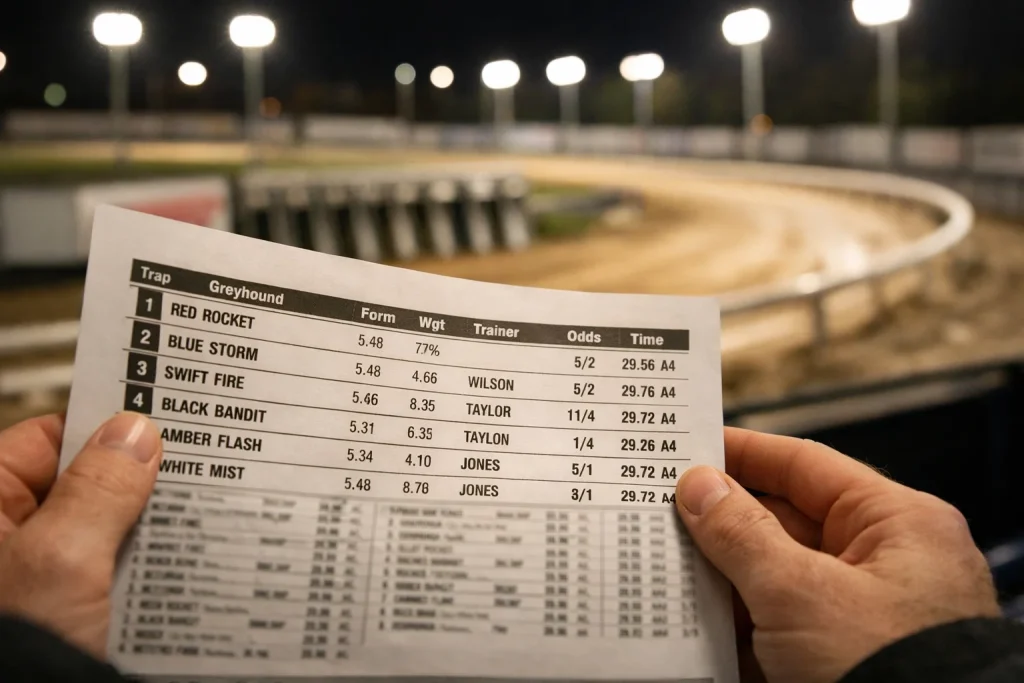
What the Hove Racecard Actually Is
I spent my first three months at Brighton & Hove staring at racecards without actually understanding them. Every Friday morning I would pick up the printed sheet at the Nevill Road entrance, scan the numbers, and convince myself I was doing form analysis. I was not. The racecard looked like a spreadsheet designed by someone who assumed every reader already knew the code — and in a sense, it was. Once I cracked the layout, though, the entire sport opened up.
A Hove racecard is a GBGB-formatted document specific to Brighton & Hove Greyhound Stadium. It is not the same as an Irish IGB card, which uses a different column structure, or a Romford card with its own quirks. The Hove version carries trap draw, dog identity, weight, trainer, grading from A1 to A9, a recent-form line, sectional times, SP and BSP columns, and analyst notes. Seven distances run at this track — from 285m sprints to 970m marathons across a 455-metre circumference — and every column on the card interacts differently depending on which trip the race covers.
This piece works left to right, top to bottom through a standard Hove racecard. Each section handles one column or block, explains what data it holds, and shows the form signal it gives an analyst. By the end, you will read a Hove card the way I do after nine years of staring at them — which is to say, quickly, and with purpose.
See also: hove greyhound results — your complete guide to Hove greyhound racing.
The Header Block: Meeting Date, Grade and Distance
A colleague once missed an entire evening’s analysis because he had been reading a Wednesday afternoon BAGS card while the actual meeting was a Saturday evening open. The header block exists to prevent exactly that kind of mistake, and yet it is the part most people skip.
At the very top of every Hove racecard you will find the meeting date, the session type and the race-level information: distance, grade and race number. The date is straightforward, but the session type carries weight. Hove runs five meetings per week — Wednesday and Sunday afternoons, Friday morning, Thursday and Saturday evenings — and the session determines the grade mix. Afternoon BAGS cards tend to cluster around A4 to A7 grading, while evening open-race meetings pull from A1 to A3 with the occasional novice or puppy race mixed in.
The distance figure sits right below. On a 515-metre race, you are looking at roughly one full lap plus an extension on the home straight. On a 285-metre sprint, the dogs barely complete a single turn. This distinction matters because the rest of the card — trap draw significance, sectional-time interpretation, weight relevance — shifts dramatically between a short sprint and a staying trip. Always check the distance before anything else.
The grade tells you the competitive band. An A1 race at Hove features the quickest dogs at the track; an A9 race, the slowest graded runners. Between those poles sit seven grades, each with a target time band that the racing manager uses to build competitive fields. The header-block grade anchors your expectation for the times and prices you will see further down the card.
Trap Draw and What Red, Blue, White Mean
The trap draw is the first column on the left-hand side, and it took me an embarrassingly long time to realise that the colour codes are not decorative. They are functional identifiers that track stewards, commentators and the photo-finish camera all rely on during a race.
Six traps, six colours, fixed across every GBGB-licensed track in Britain: trap one is red, two is blue, three is white, four is black, five is orange, and six is striped black-and-white. At Hove specifically, which is a left-handed circuit, the trap draw has a geometric consequence. Trap one sits on the inside rail. On a 515-metre race, the dog in red has the shortest path to the first bend and the best chance of establishing a rail position early. Trap six, on the outside, needs either explosive early pace or a wide-running style to avoid being squeezed into traffic.
I have seen punters dismiss trap draw entirely — “the best dog wins regardless” — and I have seen others treat it as the only factor worth considering. Both are wrong. Trap draw is a modifier, not a verdict. A quick A2 dog in trap six at 515 metres faces a measurable disadvantage compared to drawing trap one, but that disadvantage is smaller at 285 metres, where there is only one bend to negotiate, and larger at 695 metres, where the dog has to hold position through multiple turns.
When you look at the trap column on a Hove card, the question to ask is not “is this a good draw?” in the abstract. The question is whether this particular dog’s running style suits the geometry that this particular trap imposes at this particular distance. A confirmed wide-runner in trap six at 515 metres is not badly drawn — that dog was always going to run wide. A rail-hugger in the same box, though, has a problem.
Dog Name, Age, Colour and Sex
Names in greyhound racing follow a strict format: a one- or two-word prefix linked to the breeding kennel, then a suffix chosen by the owner. You will see patterns quickly. Dogs from the same litter often share a prefix. When you spot three runners on a Hove card with the same prefix — say, “Ballymac” or “Droopys” — you know they share bloodlines, which can hint at shared traits like early pace or stamina.
Next to the name sit age, colour and sex. Age is recorded in years and months. Greyhounds typically begin racing at around 18 months and peak between two and four years old. A five-year-old in an A3 race at Hove is still competitive, but the form analyst notes the age because recovery time lengthens and injury risk rises. Colour — brindle, fawn, black, white-and-black and so on — has no performance correlation, but it matters for identification during a race, particularly when the photo-finish camera cannot rely on trap jacket colour alone.
Sex is marked as “d” for dog or “b” for bitch. It matters in two specific contexts at Hove. First, the Coral Brighton Belle — one of the stadium’s four category-one fixtures — is restricted to bitches only over 515 metres. Second, bitches in season are withdrawn from cards, and the “b” marker alerts trainers and racing managers to scheduling considerations. From a form perspective, sex has less impact than many casual observers assume, but weight differences between dogs and bitches in the same grade can affect sectional times, which brings us to the next column.
Weight Column and Why One-Kilogram Swings Matter
Weight gets recorded on race day, and it appears on the card in kilograms to one decimal place. Most greyhounds racing at Hove weigh between 26 kg and 36 kg, with bitches typically lighter. The number itself tells you very little in isolation. What matters is the trend.
A dog that weighed 32.4 kg last Thursday and comes in at 31.2 kg tonight has shed over a kilogram in a week. That swing demands attention. It might indicate illness, a change in feeding routine, or pre-season conditioning. Conversely, a gain of a kilogram or more can signal that the dog has been rested and well-fed — possibly coming back from a break — or that something is off in the kennel routine.
I treat the weight column as a secondary filter. If everything else on the card looks positive — good trap draw, recent form showing improvement, sectional times dropping — but the weight has moved more than half a kilogram from the dog’s recent average, I pause. Weight volatility in greyhounds correlates with inconsistency, and inconsistency is the enemy of form analysis. The most reliable runners at Hove tend to show stable weight across four or five consecutive race-day weigh-ins, varying by no more than 300 to 400 grams.
Trainer Column and Kennel Signals
The trainer column is the one I undervalued the longest and now consider one of the most useful. It shows the name of the licensed trainer responsible for the dog, and at Hove, the trainer population is concentrated enough that you begin to recognise patterns quickly.
Roughly 500 trainers are registered across all GBGB tracks in Britain, but Hove cards are dominated by a smaller pool of locally-based kennels. Seamus Cahill, for instance, is a name that appears on Hove cards with notable frequency, and his runners tend to share a preparation style — consistent weight management, strong first-bend sectionals, a preference for the 515-metre trip. Spotting that pattern does not guarantee a winner, but it tells the form analyst something about the dog’s conditioning and the trainer’s method.
Different trainers prepare dogs differently. Some prioritise early pace and train for explosive trap exits; others condition for stamina and accept a slower first split in exchange for a stronger finish. The trainer column is your shorthand for those preparation philosophies. Over time, you build a mental database: this trainer’s dogs break fast, that trainer’s dogs finish strong, a third trainer consistently produces reliable 515-metre performers but struggles at sprint distances.
There is also a practical signal. When a dog switches trainers between appearances on the Hove card, the form line from the previous trainer may be less predictive. New kennels, new feeding regimes, new training circuits — all of it can shift a dog’s output. The trainer column is where you spot that change before the recent-form line reflects it.
Grade Column: A1 to A9
Grading is the single most useful column on any racecard, and most newcomers walk straight past it. The grade — A1 at the top, A9 at the bottom — determines which dogs race against each other. It is the racing manager’s tool for building competitive, balanced fields.
At Hove, grading works on a time-based ladder. A dog is assigned to a grade based on its recent finishing times at the relevant distance. Run faster than the grade ceiling, and the dog moves up. Run slower than the grade floor, and it drops. The system is not purely mechanical — the racing manager applies judgement, particularly around dogs switching distances or returning from injury — but the time bands provide the framework.
An A1 race at 515 metres is the fastest grade at the track’s flagship distance. Dogs in A1 are running sub-30-second times with regularity. The 515-metre track record, 29.30 seconds, was set at an elite level that even most A1 runners will never approach. At the other end, an A9 race features dogs running times above 31 seconds at the same distance — still fast by any standard, but meaningfully different in competitive terms.
The form signal from grading is directional. A dog that has been upgraded from A4 to A3 is improving. One that has dropped from A2 to A4 over three races is declining, and the recent-form line will usually confirm why. The grade column also interacts with the price columns: a newly upgraded dog often starts at a longer price because the market has not yet adjusted to its improved form, while a dog dropping through grades may shorten in price because the opposition is weaker.
One trap for new readers: do not compare grades across tracks. An A3 at Hove and an A3 at Romford reflect different time bands because the circuits differ. The 455-metre circumference at Hove, with its particular bend geometry, produces different finishing times from Romford’s 400-metre loop. Grading is track-specific, and treating it as a universal ranking is a mistake I have seen too many newcomers make.
Recent Form Line: Reading the Last Six Runs
There is a moment — usually around your fiftieth racecard — when the form line stops looking like a string of random numbers and starts reading like a sentence. That moment changed how I approach every Hove meeting.
The recent-form line shows the dog’s last six runs, typically presented as finishing positions (1 through 6) with associated times and distances. At Hove, the form line reads right to left: the most recent run is on the right, the oldest on the left. Each entry gives the finishing position, the distance, the time, and often the venue if the dog has raced at another GBGB track between Hove appearances.
The obvious reading is trajectory. A form line of 5-4-3-2-1 shows a dog in improving form — each run better than the last. A line of 1-1-2-4-5 shows one heading the wrong way. But the obvious reading is rarely the complete reading. You need to cross-reference each position with the grade it was achieved in. Winning an A7 race is not the same as finishing third in an A2 race, and the form line alone does not distinguish between the two without the grade context from the header block.
Distances matter here too. A dog showing a form line of 3-2-1-4-6 might look inconsistent until you notice that the first three runs were at 515 metres and the last two were at 695 metres — a staying distance that does not suit the dog’s profile. The form line flagged the problem, but only if you read the distance alongside the position.
I also look for gaps in the form line. A run marked with a letter code instead of a number — “R” for refused to race, “F” for fell, or a blank indicating a void — tells a story that the finishing position cannot. A dog that fell two runs ago and has since finished fourth and fifth may be carrying the physical or psychological effects of that incident. That matters more than the raw numbers suggest.
The most useful habit I have built is reading the form line from left to right first, then right to left. The leftward scan shows the oldest runs and establishes a baseline. The rightward scan shows the trend. If the two readings agree — consistently improving or consistently declining — the signal is strong. If they contradict each other, the dog’s form is volatile, and volatile form at Hove usually means the dog is either changing distances, switching trainers, or returning from a break.
Sectional Time and Why It Beats Finish Time
Finish time tells you how fast a dog completed the race. Sectional time tells you how that speed was distributed. The difference between the two is the difference between knowing a dog ran 30.10 seconds and knowing it ran 4.50 seconds to the first bend and 25.60 seconds from there to the line.
At Hove, the sectional split measures the time from the traps to a marker point, typically the first bend. A fast first-bend sectional — say, 4.30 seconds on a 515-metre race — indicates a dog that breaks sharply from the traps and reaches the turn ahead of the field. That early speed has tactical value: the dog at the front entering the first bend avoids crowding, holds the rail, and forces rivals to run wider and cover more ground.
But fast sectionals come with a cost. A dog that clocks 4.30 to the bend but fades to a 30.80 finish has spent its energy early. The sectional reveals the fade; the finish time alone would just show a moderate result. Conversely, a dog with a 4.80 first-bend sectional that finishes in 29.90 is a strong closer — slow out, fast finish. That running style carries its own risks, particularly at Hove’s 515-metre trip where first-bend traffic can leave a slow breaker with too much ground to make up.
I use sectionals to separate dogs that look similar on finish time. Two runners both clocking 30.20 at 515 metres appear identical — until you see that one ran 4.35 to the bend and the other ran 4.70. The first is a pace-setter likely to lead into the turn; the second is a closer who will be chasing from the back of the field. The tactical dynamic of a race depends on how many pace-setters and closers are drawn together, and the sectional column is where that picture emerges.
SP, Forecast SP and BSP Side Columns
The right-hand side of a Hove racecard carries the money columns, and this is where a lot of newcomers get confused — because there are two different price systems sitting side by side, each generated by a completely different mechanism.
SP — Starting Price — is the traditional market price. It represents the consensus odds offered by on-course bookmakers at the moment the traps open. A panel of SP reporters records the prices displayed in the ring, and the official SP is calculated as a median of those offers. This is the price that off-course bookmakers settle most bets against. On a typical Hove evening card, the SP for a short-priced favourite might sit at 2/1, while an outsider drifts to 10/1 or beyond.
BSP — Betfair Starting Price — works differently. It is a single exchange-derived price generated by the Betfair platform at the moment the race begins, calculated from the weight of money matched and unmatched on the exchange. The BSP and SP can diverge significantly. On Hove afternoon BAGS meetings, where on-course attendance is lower and on-course bookmaker activity thinner, the BSP often drifts higher than the SP because the exchange reflects a broader pool of opinion. On well-attended Saturday evening cards, the two prices tend to converge.
Off-course turnover on greyhound racing reached roughly £794 million in the 2023-24 financial year, which means the SP carries substantial commercial weight. The forecast SP column — sometimes marked as “tissue” or “forecast” — shows the predicted opening price before live trading begins. It is an estimate produced by the track’s pricing team, and it can shift dramatically once money starts flowing.
For the form analyst, the price columns serve as a cross-check. If your card reading suggests a dog should be competitive but the SP is long, the market disagrees with you. That disagreement is worth investigating. It might mean inside information — a trainer concern, a weight swing spotted by the kennels — or it might mean the market is simply wrong. Either way, the price column makes that tension visible.
Analyst Column and Stewards’ Notes
Tucked at the far right or along the bottom of certain Hove racecards, the analyst column and stewards’ notes carry qualitative information that no other column provides. The analyst column is editorial: a brief comment from the track’s form compiler about a dog’s recent runs, its suitability for the draw or distance, or any concern flagged by the kennels. These notes are not standardised across GBGB tracks — what Hove’s compiler emphasises might differ from what you see at Monmore or Sunderland.
Stewards’ notes, by contrast, are official. They record any incident from a dog’s previous race: interference at the first bend, a check in running, a false start, or a stewards’ inquiry that affected the result. GBGB’s own published commentary on track-level injury and retirement data confirms that the regulator tracks incidents systematically — the record-low injury rate of 1.07% across 355,682 runs in 2024 is built from exactly this kind of granular race-by-race reporting.
Most racecard readers ignore these notes entirely. That is a mistake. A dog that suffered interference at the first bend two runs ago, losing three or four lengths, will show a poor finishing position on the form line — but the stewards’ note explains why. Without that context, you might write the dog off as declining when it was simply unlucky. The analyst column is where the card stops being a spreadsheet and starts being a narrative.
Putting It Together: One Hove Race in Full
Let me walk through a single race on a Hove card the way I would on a Thursday evening at Nevill Road. The race is a hypothetical A3 515-metre contest — six runners, evening open meeting.
Start with the header: A3 grade, 515 metres, Thursday evening. This tells me the field is mid-to-upper quality, the distance is Hove’s flagship trip, and the meeting type means these dogs are running under floodlights on a card that typically draws stronger entries than a Wednesday afternoon BAGS session.
See a Hove racecard example walkthrough.
Move to the trap draw. The dog in trap one is a confirmed rail-runner — I know this from the form line and from the trainer’s preference for inside draws at this distance. In trap six, there is a wide-runner from a kennel known for producing dogs that ping the lids and go straight to the front regardless of draw. The middle traps hold four dogs with mixed running styles. Already, from just the trap column, I can picture the likely shape of the first bend: trap one on the rail, trap six going wide, and a battle for position among the four in between.
Check the weight column. Trap three’s dog has gained 1.3 kg since last week. That is a large swing. I note it and keep going. Trap five has been stable at 31.8 kg across five consecutive weigh-ins — that dog is well conditioned and consistent.
The trainer column shows two dogs from the same kennel (traps two and four). That is not unusual at Hove, where a small number of trainers dominate the cards. I know this trainer prioritises early pace, so both dogs are likely to break sharply. If they are drawn next to each other — traps two and four, separated by only one box — there is a risk of internal interference at the first bend.
Grading context: one dog has just been upgraded from A4 to A3. Its form line shows 2-1-1 at A4 — dominant at the lower grade. The question is whether it can handle the step up. Another dog has dropped from A2 to A3 after two fifth-place finishes. The form line looks poor, but the grade drop means it is now racing against slower opposition, which might reverse the decline.
Sectional times separate two dogs that both ran 30.15 last week at A3 515 metres. One clocked 4.38 to the first bend; the other, 4.72. The fast breaker is in trap one. The closer is in trap five. If the fast breaker in trap one leads into the first bend and holds the rail, the closer in trap five will need to find a clear run from the back of the field — a tall order against five other dogs in a six-runner race.
The SP forecast has the trap-one dog at 5/2, the newly upgraded runner at 7/2, and the trap-six wide-runner at 4/1. The weight-gainer in trap three is forecast at 8/1 — the market has noticed the swing. I would not disagree with that assessment.
Finally, the analyst notes. Trap four’s dog has a stewards’ note from its last run: “checked first bend, lost two lengths.” That explains the fourth-place finish on the form line. Without the note, the dog looks ordinary. With it, the dog looks like a victim of circumstance — still capable of A3 grade but let down by traffic last time out.
That is how the entire card comes together. No single column gives the answer. Every column gives a piece. The racecard is not a prediction engine — it is a diagnostic tool, and the skill lies in understanding how each distance at the Hove circuit reshapes the relative importance of each column you have just read.
