
A Full Hove Racecard, Read Row by Row
 Available in US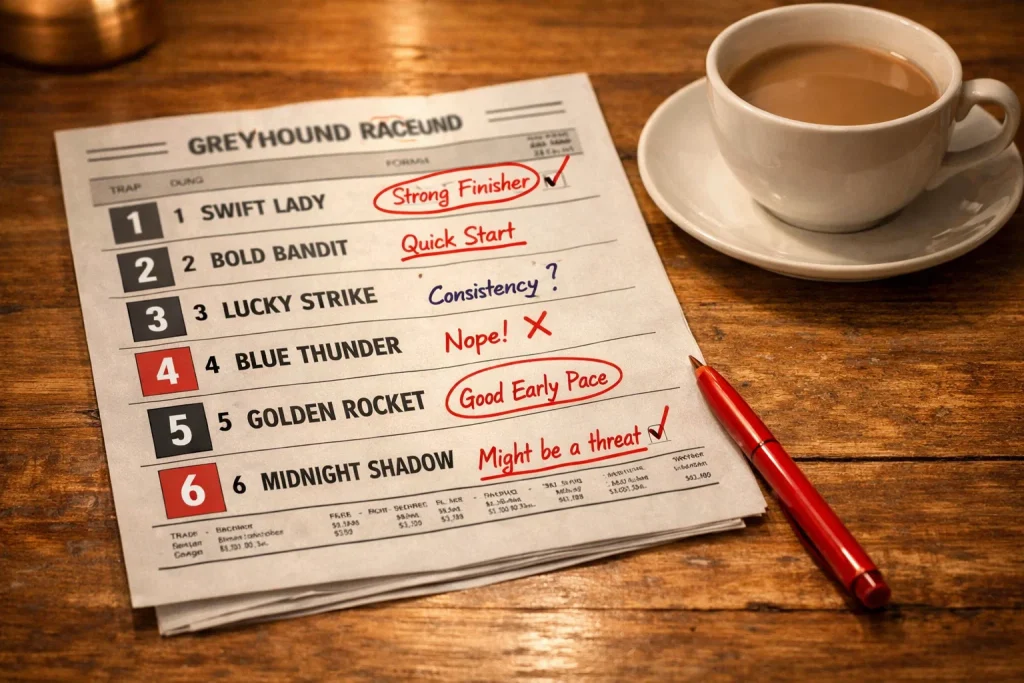
The card we’re reading
This isn’t a tutorial about what each column on a racecard means — I’ve covered that ground elsewhere. This is a worked example. One race, six dogs, every row read the way I’d read it if I were sitting down with the card on a Thursday evening before the meeting started.
The race is a standard A4 graded contest over 515m at Hove — the stadium’s benchmark distance on a 455-metre circumference. The 515m track record stands at 29.30 seconds, set by Barnfield on Air in 2007, which gives you the absolute ceiling; an A4 race will produce times in the 30.00 to 30.80 range depending on the field, the draw and the conditions. Six runners, six trap colours, six form lines that each tell a different story. Hove’s distance portfolio spans seven trips from 285m to 970m, but 515m is the distance where grading separates most cleanly and form reads most reliably.
See also: hove greyhound results — your Hove greyhound portal.
Trap 1: the rail-runner favourite
The dog in trap 1 is where I always start, because the inside draw at Hove 515m is the most structurally advantaged position on the card and the market knows it. This dog is an established A4 — three recent wins at the grade, consistent sectional times, and a form line that reads cleanly left to right: first or second in every recent start.
What the form tells me. The recent 515m times cluster around 30.15 to 30.25, which puts this dog at the sharp end of A4. The sectional column confirms fast breaks in two of the last three runs — the dog gets to the rail before the first bend and holds the line. Running comments note “railed” and “led throughout” as recurring descriptions. This is a dog doing what it’s supposed to do from this trap: clean break, rail line, uninterrupted run. The market will price it accordingly — short, justified, and difficult to oppose on form alone.
Trap 2: the in-form up-grader
Trap 2 has a dog that’s just arrived at A4 from A5. Two wins and a second from three recent runs at the lower grade, with improving times that triggered the grade promotion. This is the row that requires the most careful reading, because an up-grader is simultaneously the most exciting and the most dangerous runner on the card.
Why dangerous. The dog’s recent times — 30.30 to 30.40 at A5 — are competitive at A4, but only just. The gap between A5 form and A4 form is roughly two to three tenths of a second at Hove 515m, and this dog’s best time sits right on the boundary. If the dog finds the same rhythm at A4 that it found at A5, it’s a live contender. If the step up in field quality — faster rivals, tighter first bends, more tactical racing — disrupts the rhythm, the dog finishes mid-pack and the form line looks flat next time out. I watch the sectional on an up-grader’s first run at the new grade more closely than anything else on the card.
Trap 3: the mid-draw specialist
Trap 3 contains the dog with the most interesting form line on this card. It’s an established A4 with a winning strike rate that’s unremarkable — one win in the last six — but with a pattern in the sectional-to-finish delta that tells a much better story than the raw results suggest.
The delta pattern. This dog has run slower first sectionals than the field average in four of six recent runs, but finished in the top three in five of those six. That means it’s a dog that typically breaks behind the field and makes up ground through the race — a closer, not a leader. Drawn 3, it sits in the middle of the field at the break, which suits a closer perfectly: the dog can settle behind the early pace, avoid the first-bend congestion, and pick off tiring leaders on the run to the line. The form that looks average on a finishing-position read looks significantly better on a sectional-delta read. This is the row that separates form readers from result readers.
Trap 4: the wide-runner with a grade drop
The trap 4 dog is dropping from A3 to A4 after three consecutive finishes outside the top three at the higher level. Grade drops are common at Hove — the grading system is designed to move dogs up and down based on recent performance — and this one follows a typical pattern: strong early-career improvement, promotion to a grade slightly beyond the dog’s ceiling, and now a return to the level where the form was most competitive.
The form read on a grade-dropper. First, ignore the recent A3 finishes — they were against dogs running two-to-three-tenths faster, and mid-pack in A3 is a different story from mid-pack in A4. Second, look at the A4 form from before the promotion: this dog was winning at A4 before it was promoted, so it has a proven record at the level. Third, check the running comments for signs of demoralisation — a dog that’s been running poorly at a grade above its ceiling can sometimes carry that deflation into the first race back at a lower level. Running comments that mention “never competitive” or “outpaced” at A3 are different from “kept on” or “every chance” at A3. The former suggests the dog was overwhelmed; the latter suggests it was competitive but not quite fast enough.
Trap 5: the maiden
Trap 5 has a maiden — a dog that hasn’t won a race yet at Hove. Maidens at A4 are uncommon but not unheard of: the dog has qualified with times good enough for the grade but hasn’t converted qualification form into a race win. The form line shows a string of seconds and thirds, which means the dog finishes close but doesn’t lead.
What the maiden designation means for form analysis. The absence of a win doesn’t mean the dog can’t win — it means it hasn’t yet, which is a different statement. A maiden with consistent top-three finishes and improving sectionals is a dog whose turn is coming; the question is when, not if. A maiden with erratic form — a second, then a sixth, then a third — is a dog you can’t rely on, because the variance suggests either inconsistent fitness or a temperamental issue that disrupts performance unpredictably. This particular maiden falls into the first category: consistent, improving, close. The trap draw at 5 is the complication — outside-middle isn’t ideal for a dog that hasn’t shown a strong preference for either the rail or the wide line.
Trap 6: the stamina runner
The dog in trap 6 is the oddity on this card. It’s primarily a 695m runner — a stayer by profile — dropped to 515m by the racing manager, either because the 695m card was full or because the trainer wants to test the dog’s speed over a shorter trip. The recent form is all at the longer distance, with times that tell you about stamina and pace but not about break speed or cornering technique at 515m tempo.
Reading a stayer at a sprint distance. The first sectional is the diagnostic. If this dog produces a first-bend split comparable to the field, it’s adapted to the shorter trip and has a genuine chance — stayers with sufficient early pace can be dangerous at 515m because their stamina advantage kicks in over the final 100 metres when the speed dogs are tiring. If the first-bend split is materially slower than the field, the dog is running its 695m style at 515m pace, and by the time it finds its rhythm, the race is over.
Verdict: reading the shape of the race
Six dogs, six stories. The race shape that emerges from reading the card row by row is more complex than any single-column analysis could reveal. The trap-1 rail-runner is the form pick — short-priced, justified. The trap-3 closer is the value pick if you trust sectional-delta analysis over finishing positions. The trap-2 up-grader is the risk play. The trap-4 grade-dropper is the reset candidate. The trap-5 maiden is close but unproven. The trap-6 stayer is the wildcard.
Learn how to read a Hove racecard.
Professor Madeleine Campbell, an EBVS European Veterinary Specialist, has emphasised that what GBGB has put in place represents a world-class welfare approach — and that’s the structural background behind every form data point on this card. Each row draws on regulated, traceable data: official times, verified weights, veterinary-checked health, steward-observed races. The form read I’ve walked through is only possible because the data is generated within that regulatory framework. Without it, you’re reading numbers without context.
A card like this one is a puzzle with six pieces, and the skill of the form analyst is in assembling them into a prediction that accounts for draw, grade, style, trend and conditions simultaneously. The complete Hove track guide covers the broader data landscape that makes this kind of row-by-row reading possible.
