
SP vs BSP in Greyhound Betting: How the Two Hove Prices Differ
 Available in US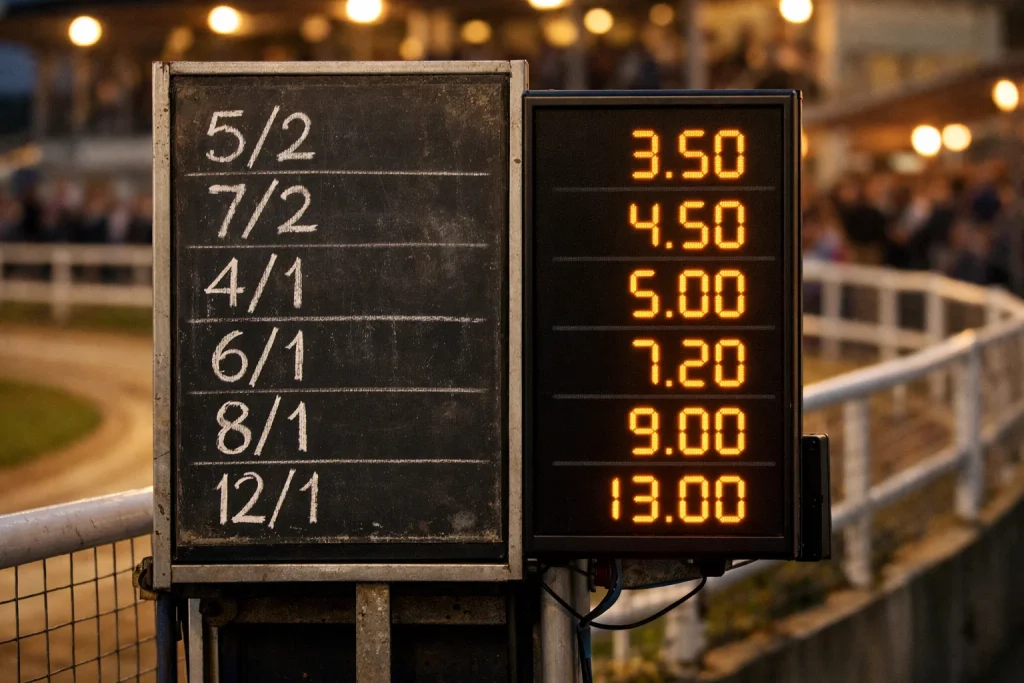
Two prices on one Hove result line
The first time a punter looks at a Hove result and sees 5/2 next to a longer decimal — say 4.12 — the temptation is to assume one of them is wrong. They’re not. They’re two different prices for the same dog, set by two different markets that closed at the same instant, and after nine years of writing up Hove cards I still see people miss money because they don’t understand the gap between them.
SP is the Starting Price — the traditional off-course average that British bookmakers settle from. BSP is the Betfair Starting Price — the exchange-side equivalent, drawn from a reconciliation of back and lay orders at the off. Both appear next to every Hove finishing line on a serious results service, and both tell you something the other doesn’t. The point of this article is to walk through how each is constructed, why they diverge on Hove evening cards, and how to convert either into the implied probability you actually need before you weigh up form.
See also: hove greyhound results — comprehensive Hove greyhound coverage.
What SP is and how it is determined
I once watched a steward at a regional meeting argue with a punter for ten minutes about whether 7/4 or 15/8 was the correct return on a winning slip. The argument was about pence. It was also about a centuries-old mechanism most casual punters have never had explained to them — and it’s the same mechanism that produces every SP printed on a Hove result line.
The Starting Price is the price returned at the off, agreed by a panel of senior on-course bookmakers based on the prices being quoted on their boards in the final seconds before the traps open. For greyhound racing the methodology is broadly inherited from horse racing: a representative sample of on-course books is observed, a working majority is taken, and the SP is published as a fraction (5/2, 11/4, 7/1) for off-course settlement.
Three things matter about that mechanism. First, SP is a snapshot. It captures the market at one moment, not an average over the betting window. A dog that was 6/1 ten minutes before the off and 9/2 thirty seconds before will go down at 9/2, not somewhere in between. Second, SP is publisher-driven. The bookmaker boards reflect their own books — the layoff they’ve already taken, the liabilities they want to reduce — not pure market sentiment. And third, SP is binary in form: every winning bet at SP is settled at exactly that price, which makes it the universal anchor for ante-post settlement, each-way places and any of the dozens of derivative bets that reference the off-time price.
For Hove specifically, the SP appears in the GBGB result feed within minutes of each race. Off-course betting turnover on greyhound racing reached approximately £794 million in the year to March 2024 — the lion’s share of that money settled at SP. So when a Hove dog goes down at 11/4, that fraction is doing the work for off-course shop bets, online fixed-odds bets and all the small-stakes accumulators that ride on the price returned at the moment those traps open.
What BSP is and how Betfair calculates it
Walk into a betting shop in Brighton on a Wednesday afternoon and you’ll see SP returns flashing on the wall in fractions. Open a Betfair tab on your phone in the same shop and you’ll see something that looks like a different sport entirely — a spreadsheet of decimal numbers shifting every second, with a single value labelled BSP that materialises only at the off.
BSP — Betfair Starting Price — is the price calculated by the exchange at the moment the race begins, by reconciling all unmatched back and lay orders that were sitting in the SP queue when the traps opened. The mechanism is a clearing-price algorithm: it finds the single decimal price at which the maximum number of pounds backed and laid can be matched, and that becomes BSP for that selection. Anyone who placed a back-to-SP or lay-to-SP order before the off is settled at that calculated value.
BSP behaves differently from SP in three ways that matter for reading a Hove result. It’s a market-clearing number, not a quoted board number — so it reflects exchange liquidity, not the bookmaker’s risk position. It’s expressed as a decimal (4.12, 6.40, 11.50) which makes implied-probability arithmetic transparent, and which I’ll come back to in the closing section. And it’s a single global figure: there’s no panel, no representative sample, no judgement call. The exchange code does the calculation and publishes the number.
One more piece of context. Online (remote) gambling GGY reached £7.8 billion in the year to March 2025, up by more than £900 million — and exchange volume is a measurable share of that growth. BSP isn’t a niche curiosity any more. For Hove evening cards in particular, the exchange market on the headline races can carry serious money, and the BSP that prints next to the SP is the market-clearing read on what the exchange thought the dog was worth at the off.
Why the two prices diverge at Hove evening cards
The cleanest example I can give you of SP-to-BSP divergence happened on a Saturday-evening Hove card a few years back. A 515m middle-grade dog went down at 4/1 SP. BSP printed 6.20. That’s a meaningful gap — a punter who took BSP made roughly 24% more on the same winning ticket.
Three drivers explain that kind of gap. First, the late-money pattern. SP captures the boards in the final seconds; BSP integrates orders across the whole pre-off window into one clearing calculation. If the late money is short — heavy back-orders piling in just before the off — SP will compress while BSP, which has already absorbed earlier laying interest, can settle longer. On Hove evening cards with a strong card-headliner, this asymmetry is common.
Second, exchange liquidity at Hove. The total pool on a mid-week BAGS race might be modest — small lay orders move the BSP a long way. On a high-profile Saturday card, the pool deepens and BSP tightens toward SP. So the gap you see is partly a function of which Hove fixture you’re looking at: BAGS afternoon races show wider, noisier divergences than category-night main events.
Third, the bookmaker layoff dynamic. As Mark Moisley of GBGB has put it, “Revenue from bookmakers is declining year-on-year and has done for a number of years. If it continues at the rate it’s going, we’ll have issues sooner rather than later.” When bookmakers run thinner books, they price more defensively at the off — narrower SPs, less appetite for laying long-odds runners. The exchange, by contrast, is indifferent to layoff risk: it just clears orders. The structural pressure on the bookmaker side is one of the slow-moving reasons SP and BSP have drifted further apart on UK greyhound racing over the last several years.
Practically, what this means at Hove: never assume the two prices are equivalent on the same race. They shouldn’t be, and on most evening cards they won’t be. Read both. The gap between them is information, not noise.
Converting either price into implied probability
Here is the single most useful piece of arithmetic in greyhound betting, and most people who place bets on Hove never do it. Implied probability — the percentage chance the market thinks a dog has of winning, expressed as a number you can compare directly to your own form-read.
Understand Hove greyhound grading from A1 to A9.
From decimal odds the calculation is one step: 1 divided by the decimal price, multiplied by 100. A BSP of 4.00 implies 25.0%. A BSP of 6.40 implies 15.6%. A BSP of 11.50 implies 8.7%. From a fractional SP it’s two steps: convert the fraction to a decimal first by dividing the numerator by the denominator and adding 1, then apply the same formula. So 5/2 SP becomes 3.5 decimal, which implies 28.6%. 11/4 becomes 3.75, which implies 26.7%. 6/1 becomes 7.0, which implies 14.3%.
Three rules of thumb after you start running the numbers. First, the SP-implied number always overstates the true market view because the bookmaker margin (the overround) is baked in — sum the implied probabilities for every dog in a Hove race priced at SP and you’ll typically get something between 110% and 125%. The BSP equivalent runs much closer to 100%, because the exchange margin (commission on net winnings, not on price) is structurally smaller. So BSP-implied probability is a more honest read of where the market sat.
Second, the gap between your form-read probability and the BSP-implied probability is your edge. If you’ve worked the form and judged a 515m dog at Hove deserves a 22% chance to win, and BSP implies 15%, that’s a value bet by definition — regardless of whether the dog wins or loses on the night. This is the analytical lens that converts price-reading from spectator activity into something with discipline behind it.
Third, the same dog at SP and BSP can look like a different bet purely because of the price. If you’re settling at SP, factor in the overround pressure. If you’re settling at BSP, factor in exchange commission. The implied-probability calculation is the only honest comparator — it strips out fractions, decimals and operator-specific quirks and gives you one number per runner. Once you start reading Hove results that way, the two-price line stops looking like noise and starts looking like the cleanest market signal British greyhound racing produces.
If you want the wider context — how Hove sits within the GBGB results feed, the fixture calendar that produces the cards these prices settle on, and the welfare framework around it all — the complete Hove track guide is the place to go next.
