
Hove Trap Statistics at 515m: Which Box Wins Most Often
 Available in US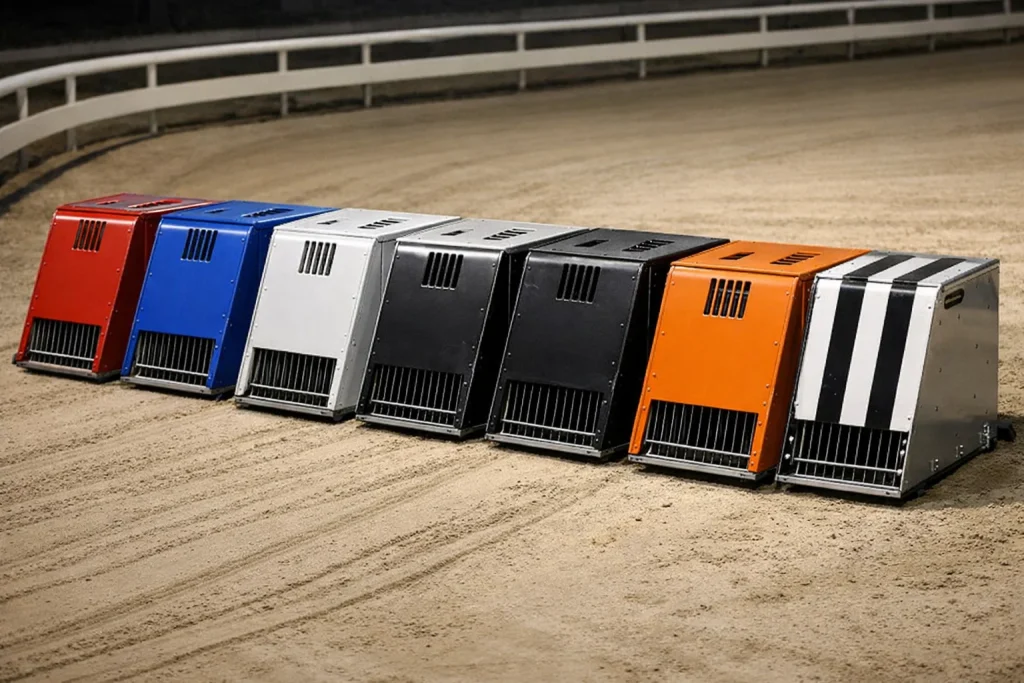
Trap bias at a 455m circuit
Most trap-bias articles I’ve read for UK greyhound tracks treat the six boxes as if they were lottery balls — equal probability, give or take some run-of-the-mill noise. That’s not how Hove works. Hove is a left-handed track with a 455-metre circumference, and the 515m start sits in a position where the angle of approach to the first bend rewards specific running styles in a measurable, repeatable way.
What follows isn’t theory. After nine years of grading Hove cards I can tell you that the trap stats on this circuit are read alongside three things: the dog’s running style, the grade of the race, and the time of day the card runs. None of those matter if you don’t first understand what the geometry is doing to each of the six boxes. So we’ll take them in order.
See also: hove greyhound results — expert Hove greyhound coverage.
Trap 1 (red): rail-runner advantage
Trap 1 at Hove 515m is the box I check first on every card. There’s a reason — and it isn’t just “inside draw, faster route.” Hove’s first bend is roughly 80 metres from the trap line, which means the dog out of trap 1 has just enough run-up to clear the box and find the rail before the field arcs into the turn. A genuine rail-runner — a dog whose preferred line is hugging the inside white line through both bends — converts that geometry into measurable extra speed.
The two signals to look for in form. First, the dog’s previous wins listed at Hove 515m or at comparable left-handed circuits in the 470m to 525m range — this tells you the running style has been tested at the trip. Second, sectional times faster than the field on inside-draw runs and comparable when drawn middle. A pure rail-runner gains time from the box, not from the bend.
Where trap 1 stops being an advantage. If the dog is a slow breaker, the 80-metre run-up isn’t enough to establish the rail before the wider runners crowd inside, and a genuine inside-runner can end up sandwiched against the white line by trap 2 and trap 3 dogs cutting across. The form column to read is the first sectional time, not the trap. Trap 1 with a slow first split is one of the worst draws on a Hove 515m card. Trap 1 with a fast first split is, on a good week, the best.
Traps 2-3: the middle-draw profile
I lost faith in middle-draw form analysis early in my career and had to rebuild it. The mistake I’d been making was treating traps 2 and 3 as variants of trap 1 — slightly worse, slightly more compromised. They’re not. They’re a different category of draw with their own logic.
The middle draw at Hove 515m sits in a zone where the dog has to pick a line. Hard inside puts you behind a quicker trap 1 dog. Hard outside puts you across the path of trap 4 and trap 5. Most dogs split the difference, which means the early racing line through the first bend is congested. Trap 2 and trap 3 dogs win this trip when one of two things is true: they break fast enough to get clear of the trap-1 rail-runner before the bend, or they’re patient enough to settle behind the field and pick off tired finishers down the home straight.
What the stats look like on form. Middle-draw winners on Hove 515m skew toward consistent grade-runners — A2, A3, A4 dogs with dependable sectional times and a pattern of finishing on rather than fading. A wild-running early-pace dog drawn middle is a poor bet on this circuit. A balanced trackcraft dog with a clean recent record is exactly where middle-draw value comes from. The grade column is doing more work than the trap column on these draws.
Traps 4-5: the outside draw
The outside draw at Hove 515m is the one I get the most reader questions about, and it’s the one with the most variance — both up and down. Trap 4 and trap 5 are the wide-runner’s natural territory on a left-handed circuit, but only if the dog actually races wide. A wide-running profile drawn 4 or 5 has a clear angle to the first bend without congestion and converts the geometry into a winning trip more often than the trap-by-itself stats suggest.
The crucial wrinkle. A railer drawn 4 or 5 has a long way to travel across the field to find the inside, and that journey costs time and exposes the dog to interference. Look at the running comments from the dog’s last three runs — “wide” or “ran wide” or “hampered switching inside” tells you how the dog handles a non-preferred draw. A railer drawn 5 with a record of being “crowded” or “checked” on outside draws is one of the trap statistics I will fade on a Hove card almost without exception.
One more pattern I’ve seen consistently. Hove 515m races with a small field of genuine wide-runners drawn together (4 and 5, or 4, 5 and 6) tend to produce slower finishing times than form might suggest, because the wide-runners take a longer route into the bend. The dog who wins these races is often the one drawn 1, 2 or 3 with the cleanest run through. Trap stats on outside draws are at their most useful when read against the running styles of the rest of the field, not in isolation.
Trap 6 (striped): wide-runner territory
Trap 6 at Hove gets either too much credit or too little, depending on the source. Casual punters see the stripe and assume it’s the worst box. Form analysts who’ve worked the circuit know it’s a specialist trap with a narrow but real edge for one type of dog: the genuine wide-running greyhound that prefers to run on the outside line throughout.
The Hove 515m approach to the first bend gives a wide-runner from trap 6 a nearly straight angle if they break fast. There’s no traffic to navigate — the inside dogs are committing to the rail, the middle dogs are sorting their line, and the wide-runner can sweep around the outside and find a clean path into the back straight. The 515m record stands at 29.30 seconds, set by Barnfield on Air in 2007 — an outright benchmark that gets approached, but not beaten, almost exclusively by dogs who break clean and find a working line off the boxes. Wide-runners drawn 6 with fast first sectionals can produce surprisingly competitive finishing times.
Where it falls apart. A trap-6 dog with a slow break — and a non-trivial number of dogs drawn there will have a slow break, because draw allocation isn’t always preference-matched — has the longest journey to the first bend and the most compromised line. The form-read on trap 6 is binary: fast breaker with wide-running history is a real chance; slow breaker with rail-running history is one of the worst draws on the card. Read the recent sectionals. The trap number alone tells you almost nothing.
How trap stats interact with grading
Hove cards a full A1 to A9 grade ladder across roughly 5 race meetings per week — Wednesday and Sunday afternoons, Friday morning, Thursday and Saturday evenings — and trap bias behaves differently at the top and bottom of that ladder. A1 and A2 dogs at 515m have refined trackcraft. They handle non-preferred draws better, find the rail or the wide line more efficiently, and the trap-statistic effect is muted. The grade is doing the heavy lifting; the draw is the tiebreaker.
Read the Hove sectional times guide.
Move down to A6, A7, A8 and the dynamic flips. Lower-grade dogs at Hove 515m are less consistent, more dependent on a clean trip, more easily compromised by congestion at the first bend. Trap stats matter much more on these races, because a railer drawn 4 in an A8 race genuinely struggles to switch lines, where the same dog drawn 4 in an A2 race might still find a way through.
The reading rule I’ve used for years. On A1-A3 races, weight grade and recent form first; let the trap nudge your read. On A6-A9 races, weight running style and trap draw first; let the grade nudge your read. The trap statistics for Hove 515m, treated as a single aggregate number, smooth over this difference and miss most of the actionable information. The grade-stratified version of the same data is where the real edge lives — and it’s why I’ve never bought trap-bias products that don’t break out by grade.
If you want the wider picture — what the seven Hove distances do to form and how the 515m sits in the broader portfolio — the complete Hove track guide sets out the full circuit context.
