
Reading Hove Sectional Times: Splits, Run-Ups and Finish Comparison
 Available in US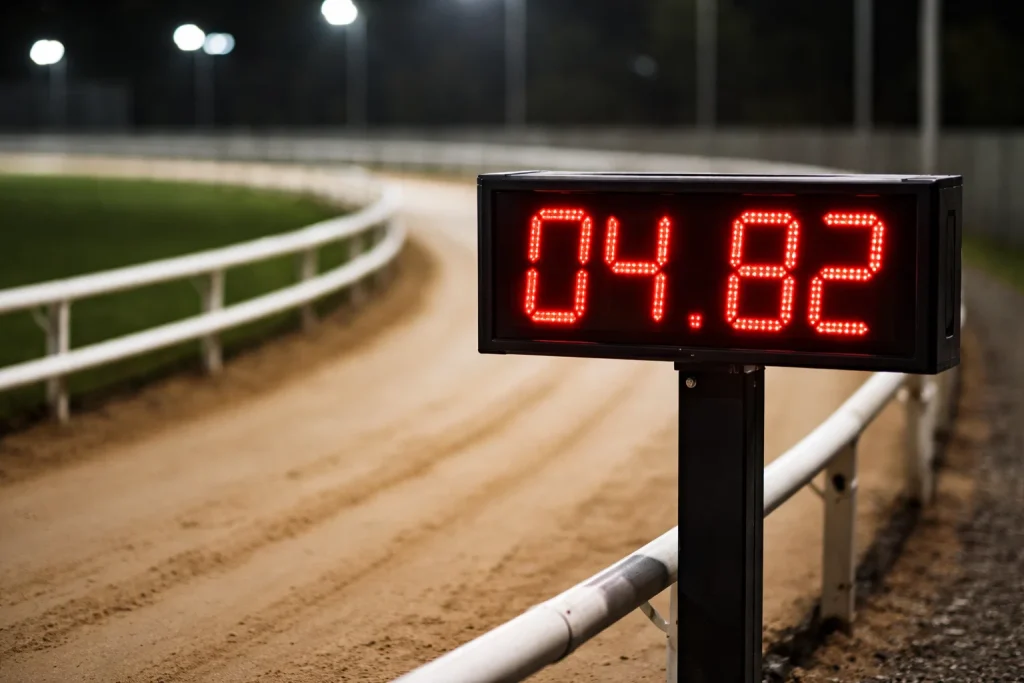
Sectional time is not finish time
Years ago I had a long argument with a punter at the rail about a Hove 515m result. He thought the winning dog had run “a fast race” because the finish time was 29.85. I told him the dog had run a slow first half and a very fast second half, and pointed to the sectional column as evidence. He didn’t believe me until I showed him three previous runs where the same dog had bled time on the bend and made it back on the straight. That’s the entire reason sectionals exist as a column on a Hove racecard.
Sectional time on a Hove card is the split measured to the first bend — not a finish time, not a halfway time, not an average. It’s a single early-pace number that tells you what the dog did between the trap opening and the first turn. Finish time tells you the verdict. Sectional tells you the story. And on Hove, where the geometry of the 455m circumference means the first bend is decisive, the story matters at least as much as the verdict.
See also: hove greyhound results — Hove greyhound racing insights.
Where Hove measures the first sectional
The sectional timer at Hove is set at the first bend on the 515m start, which means it captures roughly 80 metres of running from the trap line to the timing point. That’s a short, pure measure of break speed and acceleration — the dog’s first burst out of the box plus the run-up to the bend, before any positional traffic or cornering loss has materially affected the time.
What the placement does. It isolates one variable: how fast the dog is to the first bend. It strips out cornering speed, mid-race pace, and finishing kick — all of which still matter, but none of which the first sectional measures. That’s why a dog with a quick first split and a slow finish time isn’t necessarily a “bad finisher” — they may have spent themselves on the early pace. And a dog with a slow first split and a quick finish isn’t a “fast finisher” by some natural gift — they’re often a railer who got crowded out of the box and made up the time once the field strung out.
For the seven distances Hove cards — 285m, 475m, 515m, 695m, 740m, 930m and 970m — the sectional logic shifts with the start position. On 285m the sectional is the race; on 970m the sectional is a footnote. The 515m sectional sits in the middle of that spectrum, and it’s the most useful single early-pace number on a Hove card because the trip rewards both the early break and the late reserve. Misreading it is the most expensive form mistake I see punters make.
Reading a fast break vs a slow break
A fast break at Hove 515m looks like this on the column. The dog’s first sectional is materially quicker than the field average for that grade — call it 0.10 seconds clear in an A3 race, where field-average sectionals cluster tightly. That’s not noise. That’s the dog clearing the box and finding open ground before the bend, which on a left-handed circuit means they’re either established on the rail (drawn 1, 2 or 3) or sweeping the outside line (drawn 5 or 6) with no traffic to negotiate.
Three things follow from a fast break. The dog has set the racing line — the rest of the field has to go around or through them. Their finishing time will read faster than it would have without the break, because they’ve avoided the cornering loss that comes with switching lines mid-race. And the form-read for next time should weight the sectional as a real performance signal, not a one-off.
A slow break tells a different story. The dog’s first sectional is slower than field-average — sometimes by a tenth, sometimes more. That dog has emerged from the box behind, will have to pick a line through the field after the bend, and any finishing position better than the slowest break suggests trackcraft and finishing strength. A first-place finish on a slow break is a much more impressive performance than a first-place finish on a fast break. The sectional column lets you see which one happened.
The pattern I trust most. Two slow breaks followed by a fast break in the next form line — that’s a dog finding its rhythm. Two fast breaks followed by a slow break — that’s a dog beginning to bleed early pace, often a sign of upcoming grade-drop or a fitness issue. Sectional patterns over three or four runs tell you more about a Hove dog’s trajectory than the finishing positions do.
Sectional vs finish delta as a form signal
This is the analytical move that separates serious form readers from casual ones. The delta — the difference between sectional rank and finish rank within the same race — is a structured way of asking what the dog did after the first bend. Win the sectional, lose the race: the dog spent on early pace and faded. Lose the sectional, win the race: the dog reeled in the field on trackcraft.
Quick worked example. A 515m race where the trap-3 dog runs the fastest first sectional but finishes fourth — that dog ran out of petrol. A 515m race where the trap-1 dog runs the slowest first sectional but finishes second — that dog has an honest reserve, probably checked from the box and made up serious ground. Both performances are camouflaged by the finishing position alone. The delta makes them visible.
Where the delta gets distorted. Small fields (5 runners or fewer) compress the rank differences and the delta loses statistical signal. Heavily-graded races (A1, A2) have field-average sectionals that cluster so tightly that small absolute differences look like big rank differences. And BAGS afternoon cards with thin betting interest sometimes produce odd sectional patterns — dogs running their grade rather than racing at full extension. The delta is most reliable on Saturday evening A3-A6 fields with full six-dog cards and competitive betting markets. That’s where I trust it as a forward-looking signal.
What it lets you do that nothing else does. The delta gives you a way to say “this dog’s last finish overstates their form” or “this dog’s last finish understates their form” with a number behind the call, not a hunch. Bookmaker pricing reflects finishing positions and final times far more readily than it reflects sectional-finish deltas. The price gap between what the market sees and what the delta tells you is, in honest cases, your edge.
Adjusting sectional reading by distance
One last calibration before you take this to a Hove card. The sectional timer on the 285m start is measuring the entire race minus the run to the line — early pace is everything, sectional and finish converge into almost the same signal. The 285m record is approached only by dogs who set field-leading sectionals; there’s no time to recover from a slow break.
Check Hove trap statistics for the 515m.
The 475m and 515m sectionals work as I’ve described above — the most useful early-pace signal on Hove, balanced against the finishing kick. The 695m sectional starts to lose forward-looking power because the longer race exposes the dog to more positional change between the first bend and the line. A fast 695m sectional still matters, but it’s predicting only the first portion of the race.
On the marathon trips — 740m, 930m, 970m — the sectional is informational rather than decisive. A stayer at 970m can run a comfortably mid-field first sectional and still win, because the race is decided over more than two full circuits and the early jockeying is largely irrelevant to the outcome. I read the 970m sectional more as an indicator of intent — did the dog go off hard or settle? — than as a performance signal in its own right.
The mental discipline. Don’t transfer 515m sectional habits onto 285m or 970m form. The same column on a Hove racecard means very different things at different distances. The 515m benchmark of 29.30 seconds set by Barnfield on Air in 2007 is the reference point for all middle-distance sectional reading on this circuit, but the framework of how to read those splits has to flex with the trip. The complete Hove track guide covers the seven-distance portfolio if you want the broader framework.
