
The Coral Regency at Hove: 1948 Origins, £20,000 Purse, Recent Winners
 Available in US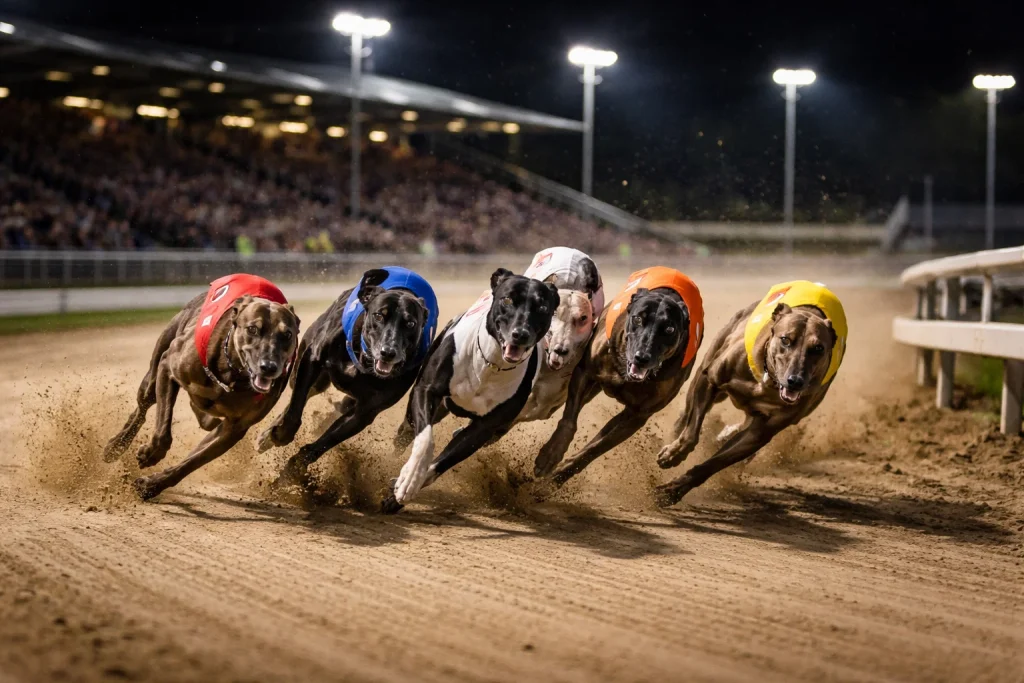
The 1948 origin and its unbroken run
Every greyhound track in Britain has one race that feels like it belongs to the place. At Hove, that race is the Regency. It’s been run under various sponsors, in various formats, across various distances — but it’s been run every single year since 1948, which makes it one of the longest unbroken fixtures in UK greyhound racing and the anchor of Hove’s category-one calendar.
The first Regency was staged in the immediate post-war years, at a time when greyhound racing was still a genuine mass-spectator sport and Brighton & Hove Stadium, barely two decades old, was establishing its reputation on the south coast circuit. The race was designed as the stadium’s flagship open event — the one night of the year when the best dogs from the strongest local kennels (and, increasingly, from further afield) converged for a prize that mattered. That basic structure has survived seven decades of economic, regulatory and commercial transformation, which tells you something about how deeply the Regency is embedded in the Hove identity.
See also: hove greyhound results — complete Hove greyhound analysis.
Prize fund and sponsor changes over the decades
The Coral Regency carries a prize fund of £20,000 — comfortably the richest purse on the Hove calendar and a significant slice of the total £15,737,122 in annual prize money distributed across British greyhound racing. The scale of that number lands differently depending on where you sit. For the winning trainer, it’s a single-night return that can underwrite months of kennel costs. For the sport as a whole, it’s one of the marquee events outside the English Greyhound Derby that pulls serious entries from multiple tracks.
How the money got there. The Regency started as a locally funded purse with modest stakes by today’s standards. Through the 1960s and 1970s, the prize grew roughly in line with the sport’s commercial footprint. The big step change came with title sponsorship — Coral’s attachment to the race brought a corporate backing level that stabilised the prize fund and connected the Regency to a national brand visible to casual punters, not just dedicated form followers.
Sponsorship has a structural effect on race prestige that goes beyond money. A Coral-branded race receives more prominent coverage on SIS feeds, draws more exchange liquidity, and generates more betting-market interest than a non-sponsored event of equivalent quality. The sponsor’s name on the race card is a signal to the market that the field will be strong, the prize is real, and the result matters beyond the track. That feedback loop — bigger brand, bigger field, bigger market, bigger brand — is one of the reasons the Regency has held its status while less well-backed races at other tracks have faded from the calendar.
Distance and format: 515m heats and final
When I first started working Hove cards, I assumed Category 1 races always ran at the track’s flagship distance. That’s broadly true of the Regency — it’s run over 515m, the benchmark Hove trip — but the format is worth understanding because it shapes the kind of dog that wins.
The Regency runs as a heats-and-final format. Entrants race through preliminary rounds over the same 515m distance at Hove, with the fastest qualifiers and semi-final winners progressing to the final. The format rewards two things that a straight final doesn’t: consistency and recovery. A dog that wins its heat brilliantly but can’t back it up 48 or 72 hours later in a semi won’t reach the final. The Regency final field is typically composed of dogs that have already proven they can produce top-grade performances on consecutive Hove cards under race conditions.
Why 515m suits the Regency. The 515m is long enough to expose pacing flaws and short enough to punish dogs with weak early speed. It’s the distance at which the full toolkit matters — break, bend, straight, finish — and the Regency final is usually the purest expression of that balance on the Hove calendar. A sprint specialist drawn into a 515m final against balanced middle-distance dogs has to be very fast to compensate for the structural disadvantage of the trip. A stayer drawn down from 695m or 740m has to sustain pace at a tempo that stayers aren’t calibrated for. The 515m is the distance where grading-ladder separation is smallest and race quality is highest.
Memorable Regency winners
Talking about individual Regency winners at Hove is a form of oral history among track regulars. Every generation has one or two dogs whose Regency run defined a season. The names that come up at the rail depend on who you’re talking to and how far back their memory reaches, but certain patterns recur.
Trainers with deep kennel strength tend to dominate the Regency over time. A single trainer winning the race in consecutive years isn’t unusual — the heats-and-final format rewards kennel depth because a trainer with three strong entries can place them in different heats and increase the chance of getting at least one to the final. I’ve watched trainers manage their Regency runners across rounds with the same kind of strategic calculation you’d see in a chess player running multiple games simultaneously — resting one dog on a particular night, pushing another to qualify comfortably rather than impressively.
The dogs themselves. The Regency rewards balanced performers over specialists. A dog that breaks fast, corners clean and finishes honest is the archetypal winner. The race has occasionally been won by a dog that set a dazzling pace from the box and held on, but more often the winner is the one that ran the most economical race — shortest route, cleanest trip, steadiest acceleration through the final 100 metres. If you’re looking for a dog to follow at Hove, studying past Regency finals tells you what the best version of a Hove 515m runner looks like under maximum pressure.
Where the Regency sits in the Hove calendar
The Regency is traditionally scheduled for the autumn or early winter window at Hove, which places it after the summer Derby season and before the Christmas-and-New-Year fixture block. That positioning is deliberate — it catches dogs that have been racing through the summer months at peak form, before the shorter days and cooler temperatures begin to affect training and trialling patterns.
Read our Sussex Cup at Hove guide.
In the broader UK greyhound calendar, the Regency occupies a slot that doesn’t clash with the English Greyhound Derby, the St Leger or the major Arc-night events at other circuits. This gives Hove a clear competitive window to attract strong outside entries — trainers from Romford, Monmore, Towcester and elsewhere can target the Regency without sacrificing qualification for a higher-profile event elsewhere on the same weekend.
For form analysts, the calendar position has a practical consequence. Autumn form at Hove correlates with specific track conditions — slightly heavier going after rain, earlier sunsets affecting evening-card visibility, temperature drops that can shift a dog’s break speed by a few hundredths. Reading a Regency winner’s form line alongside the weather and daylight data for the meeting night gives you a sharper read on whether the performance was absolute quality or condition-assisted. The Hove category one races overview sets the Regency alongside the three other Cat-1 fixtures at the stadium if you want the broader calendar picture.
