
Hove Fixtures: Five Meetings a Week and How the Card Varies
 Available in US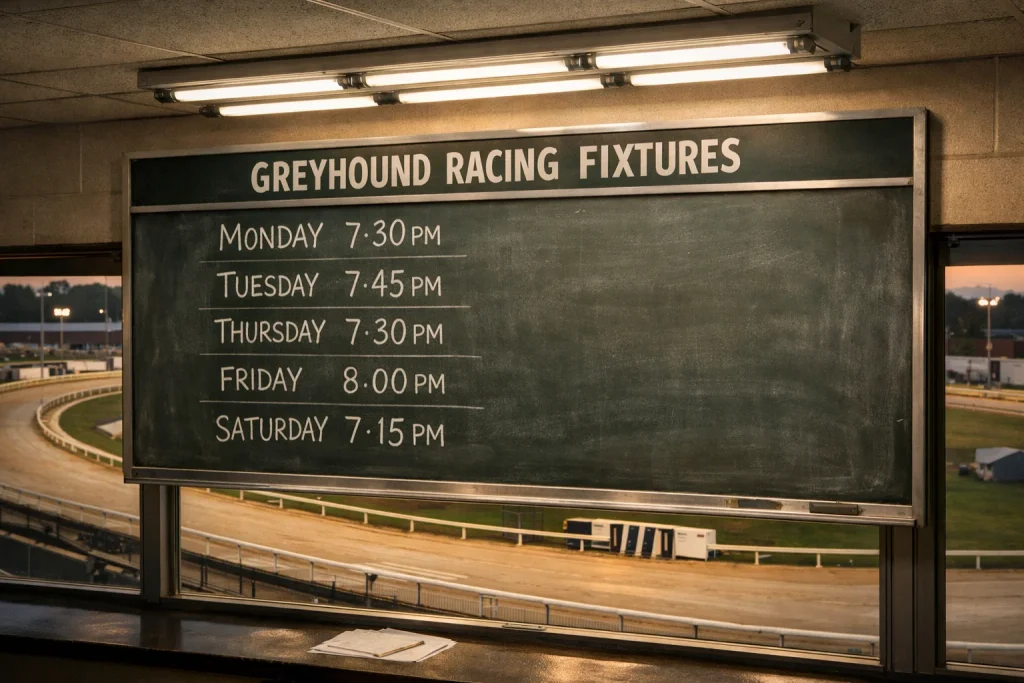
Five meetings, five different cards
The question I get asked most by people who’ve just started following Hove form is “when do they race?” The answer is five times a week — Wednesday and Sunday afternoons, Friday morning, Thursday and Saturday evenings — and each meeting produces a different card with a different grade mix, a different atmosphere and a different market. Treating them all as one homogeneous “Hove results” feed is the fastest way to misread form at this track.
Hove holds five race meetings per week, which places it among the busiest fixtures in the GBGB calendar. That frequency is the engine that keeps the stadium’s grading ladder populated, its trainer standings competitive and its results feed useful for form analysis. But “five meetings” doesn’t mean “five identical meetings.” Each slot has a character defined by the type of card it runs, the grade distribution it tends to carry, and the betting market that surrounds it. What follows is the slot-by-slot breakdown.
See also: hove greyhound results — Hove greyhound tips and results.
Wednesday afternoon: BAGS territory
Wednesday afternoon at Hove is a BAGS meeting — one of 74 BAGS fixtures staged across UK greyhound tracks every week, feeding live racing into betting shops through the SIS signal during hours when no horse racing is scheduled. That context shapes the card from the first race to the last.
The grade profile on a Wednesday afternoon leans toward the middle and lower end of the A-grade ladder. A3 to A7 is the typical range, with the occasional A2 on a strong card and A8 or A9 races filled from the qualifying pool. This isn’t a slight on the quality — it’s a structural reality. BAGS cards exist to provide a betting product during afternoon hours, and the field composition is designed to produce competitive, watchable racing rather than to showcase the top grade at the track.
For the form analyst, Wednesday afternoon Hove form needs a specific calibration. Times run on BAGS cards are reliable as grade-level indicators but not directly comparable to evening-card times at the same distance and grade, because the conditions differ — daylight, temperature, crowd noise, and the dogs’ circadian rhythms all shift between afternoon and evening racing. A 515m time of 30.10 on a Wednesday afternoon is not the same performance as 30.10 on a Saturday evening, and any form model that treats them identically is leaking accuracy.
Friday morning: early BAGS placement
Friday morning is the most unusual slot in the Hove calendar, and it’s the one that produces the most misread form. The meeting starts early — earlier than most punters would think to look for greyhound racing — and feeds into the morning SIS service, catching the window before horse racing opens.
The dogs racing on a Friday morning at Hove are, broadly, the same dogs racing on a Wednesday afternoon. The grade pool is similar, the field sizes are comparable, and the trainers entering runners overlap heavily between the two BAGS slots. What’s different is the conditions. Morning racing means cooler track temperatures in autumn and winter, dew on the sand surface in spring, and different light conditions that can affect how dogs break from the boxes. I’ve tracked Friday-morning sectional times over multiple seasons and the pattern is consistent: first sectionals run marginally slower on Friday mornings than on Wednesday afternoons at the same grade, which I attribute to the surface grip change rather than to any difference in the dogs.
The betting market on Friday mornings is thinner than any other Hove slot. Exchange liquidity is low, SP is set from a smaller market sample, and the BSP can move sharply on small order volumes. If you’re tracking SP-to-BSP divergence as a form signal, Friday mornings produce the widest, noisiest gaps — useful for identifying market inefficiencies if you have the patience to filter the noise.
Sunday afternoon: the leisure card
Sunday afternoon is the meeting that looks most like what a casual visitor imagines when they picture a day at the greyhound track. The card tends to carry a broader grade mix than the weekday BAGS slots — occasionally stretching up to A1 or A2 with a headliner — and the crowd is bigger, more mixed, and includes families and groups who are at the track for the social experience as much as the racing.
The grade distribution on a Sunday afternoon reflects this. The racing manager has more flexibility with the card because Sunday isn’t a BAGS-contracted slot in the same rigid sense as Wednesday and Friday — Hove’s Sunday card can accommodate both BAGS-funded races and additional races graded to attract the evening-quality dogs who are being kept fresh for the next Thursday or Saturday. The result is a card with more variation from race to race than any other Hove meeting.
For form purposes, Sunday afternoon at Hove is the slot where kennel management tactics are most visible. Trainers who are targeting a Thursday evening category event will often run a dog at reduced intensity on Sunday — an “educational run” where the dog breaks, races, finishes, and the trainer gets a current form line without spending the dog before the bigger meeting. Spotting these runs on the card is a skill: the finishing position might look like an under-performance, but the sectional and the running comments tell you the dog was being managed, not beaten.
Thursday evening: graded mix
Thursday evening at Hove is the first of the week’s two evening meetings, and it carries a different energy from the afternoon slots. The crowd is smaller than Saturday but more attentive — Thursday-night regulars tend to be the dedicated form followers, the people who’ve read the card in advance and come to the track with a plan rather than a pint.
The grade distribution stretches higher on Thursday than on any afternoon card. A1 and A2 races appear more frequently, the racing manager uses the slot for trial-and-qualifying races ahead of upcoming category events, and the overall quality of the card is materially better than the BAGS-dominated afternoons. This is the meeting where you’ll see trainers entering their strongest runners in open-grade races designed to test form and establish times before a Regency heat, a Sussex Cup qualifier, or any of the other category fixtures on the Hove calendar.
For form analysis, Thursday evening is the reference card. The conditions — temperature, lighting, crowd — are closest to Saturday evening (the highest-quality slot), so times run on Thursday transfer most cleanly to Saturday comparisons. If I had to choose one Hove meeting per week to study exclusively, it would be Thursday evening — the grade quality is there, the conditions are representative, and the form produced is the most forward-looking of any midweek slot.
Saturday evening: headliners and category stakes
Saturday evening at Hove is the meeting that defines the track’s public identity. The crowd is the biggest of the week, the card carries the highest-grade races, and any category-race activity — Regency heats, Sussex Cup qualifying, Brighton Belle rounds, Olympic stakes — is scheduled here whenever the calendar permits. This is the night the Skyline Restaurant fills, the night the SIS coverage runs longest, and the night the betting market is deepest.
Watch Hove greyhound racing via live stream.
The grade profile on a Saturday evening starts at A1 and works down, with the lower grades (A7, A8, A9) less represented than on any other card. The racing manager assembles the Saturday card to showcase the best available dogs at the track, which means the field quality is consistently the highest of any Hove fixture. For trainers, getting a runner on the Saturday card is itself a signal — it means the dog’s form, grade and readiness have passed the threshold for the premium meeting.
Two form-reading rules for Saturday evening at Hove. First, finishing times are the most reliable benchmarks of the week — conditions are consistent, the field quality is high, and the dogs are typically at peak readiness. Second, sectional times on Saturday evening carry more forward-looking value than on any other card, because the dogs running are often being prepared for category events, which means the trainer has a reason to let the dog run to full extension rather than managing the effort. Saturday evening sectionals are honest times. That honesty is what makes them the basis of serious Hove form analysis.
The complete Hove track guide maps the five-meeting schedule within the broader picture of what makes Hove one of the UK’s most active circuits.
