
The BAGS Service at Hove: Afternoon Greyhound Racing Explained
 Available in US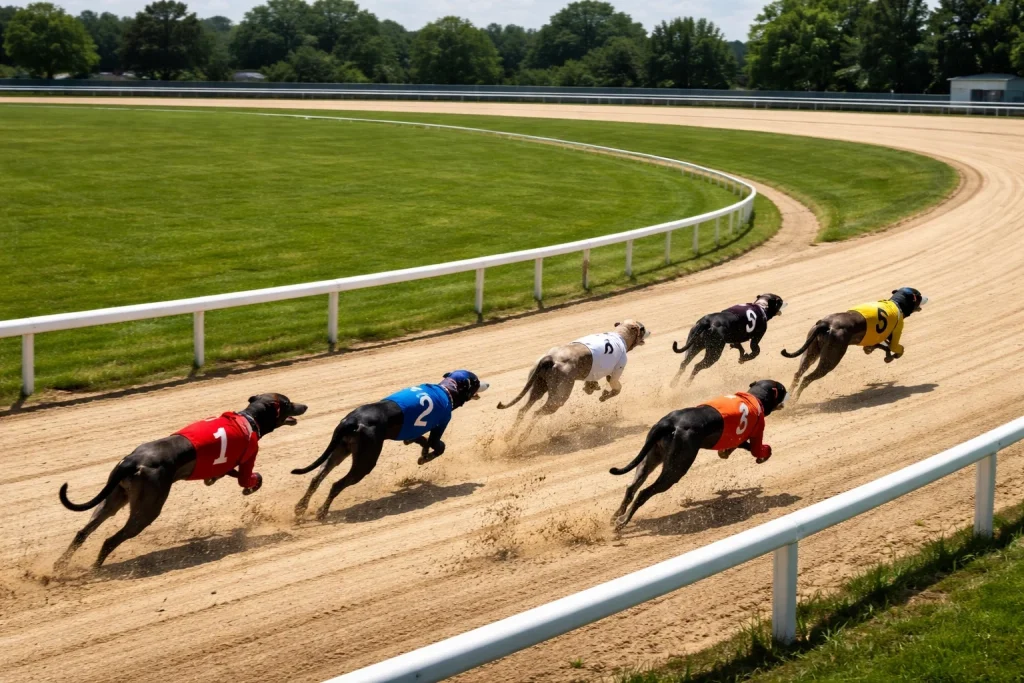
What BAGS is and why it exists
Before I understood how BAGS worked, I assumed greyhound racing happened in the evenings and that was it. Then I walked into a betting shop in Brighton at half past one on a Wednesday and there was Hove, live, on the screen. That was my introduction to the Bookmakers Afternoon Greyhound Service — and to the economic reality that afternoon racing exists because bookmakers need content when the horses aren’t running.
BAGS — the Bookmakers Afternoon Greyhound Service — is a contracted arrangement between greyhound stadiums and the betting industry. Licensed tracks agree to stage afternoon race meetings that are broadcast via SIS into betting shops and online platforms during hours when flat and jump horse racing isn’t scheduled. The arrangement provides the bookmakers with a live betting product for their afternoon trade, and it provides the tracks with a guaranteed revenue stream that supplements evening-card takings. The service generates more than 25,000 races annually across the UK, making it the largest single source of live greyhound racing content in the country.
See also: hove greyhound results — your complete guide to Hove greyhound racing.
Hove’s BAGS slots in the weekly schedule
Hove contributes three slots per week to the BAGS network: Wednesday afternoon, Friday morning and the BAGS-funded races on the Sunday afternoon card. That makes the stadium a significant BAGS venue — three of the five weekly meetings at Hove are wholly or partly driven by the afternoon service, which means BAGS is the foundation of more than half the racing that happens at Brighton & Hove Stadium every week.
Each slot has a profile. Wednesday afternoon runs through the standard afternoon window, with first race off around midday and the last race finishing by mid-afternoon. Friday morning starts earlier, catching the pre-horse-racing window when betting-shop foot traffic is beginning but no competing live product is available. Sunday’s BAGS component sits within a broader card that also includes non-BAGS races graded at a higher level, giving the Sunday meeting a split personality — BAGS-funded lower-grade races interleaved with open-graded races that can stretch to A1 or A2.
Hove holds five race meetings per week, and the three BAGS slots account for around 60% of the races staged at the stadium over the course of a typical week. That proportion matters for form analysis because it means the majority of the form data available for any Hove dog has been generated under BAGS conditions — afternoon, lower-grade, thinner market — rather than under the Saturday-evening spotlight. Read a Hove form line without knowing which meeting it came from, and you’re misreading it.
Grade mix on BAGS cards
A Hove BAGS card looks different from a Saturday evening card. The grade mix runs from A3 or A4 at the top down to A8 and A9 at the bottom, with the median race sitting around A5 or A6. You won’t see an A1 race on a Wednesday afternoon BAGS card at Hove — not because A1 dogs don’t exist at the track, but because trainers save their top-graded runners for the Thursday and Saturday evening meetings where the competition is stronger and the market is deeper.
The grade mix isn’t random. It’s constructed by the racing manager to produce competitive six-dog fields at every grade level, which means the dogs in an A6 race on a BAGS card are genuinely A6-graded — they’re running against peers, not against dogs from two or three grades above. That structural fairness is one of the things that makes BAGS form useful for analysis. The grade tells you the level, and the finishing times within that grade tell you who’s running well relative to their peers.
What catches out casual followers is the absolute time comparison. An A5 dog running 30.60 on a Wednesday afternoon BAGS card isn’t the same as an A5 dog running 30.60 on a Saturday evening, because the conditions are different (daylight, temperature, surface firmness) and the competitive pressure is different (BAGS fields with modest betting interest vs evening fields with full market support). The grade-adjusted time — where the dog’s time sits relative to the field average for that grade on that card — is the number that transfers across meetings. The raw time doesn’t.
Industry volume: 74 meetings, 5,772 dogs
Hove’s BAGS contribution is a slice of a much larger operation. Across the UK, approximately 74 BAGS meetings take place every week, with around 5,772 greyhounds competing — a volume that has grown 71% from 3,360 dogs in 2017. That growth reflects the bookmaking industry’s increasing reliance on greyhound racing as an afternoon content source, particularly as legislative and regulatory changes have reshaped the betting-shop landscape.
The scale has implications for welfare and kennel management. More BAGS meetings mean more races, which means dogs are offered more racing opportunities per week. A trainer with five dogs in training at Hove could theoretically enter all five across the three weekly BAGS slots plus the two evening meetings — fifteen individual race entries per week from a single kennel. In practice, responsible trainers manage frequency to avoid overracing, but the volume of available slots creates a structural incentive to race more often, and the GBGB’s welfare framework is designed in part to counterbalance that incentive through rest-period rules and veterinary oversight.
For the wider industry, the BAGS network is the commercial engine that keeps many tracks financially viable. The revenue from BAGS-contracted meetings — a combination of bookmaker contributions, SIS broadcasting fees and track-level betting activity — represents a significant proportion of total income for most GBGB-licensed stadiums, including Hove. Without the BAGS service, several UK tracks would struggle to sustain their current meeting schedules, and the number of active tracks in Britain — currently 18 GBGB-licensed stadiums — would almost certainly be smaller.
BAGS vs evening cards as a form signal
The question I get asked most about BAGS form at Hove: “Can I trust a Wednesday afternoon form line when I’m betting on Saturday evening?” The short answer is yes, but with calibration.
BAGS form is reliable as a grade-relative indicator. A dog that’s running consistently near the top of A5 on Wednesday afternoons is competitive at that grade. Period. What you can’t do is take the raw finishing time from Wednesday and project it directly onto Saturday without adjusting for conditions, competition quality and race intensity. A dog that runs 30.40 in a thin-market A5 on a Wednesday afternoon might run 30.20 or 30.55 in the same grade on a Saturday evening, depending on how the field shapes, what trap draw it gets, and whether the dog is being managed or fully extended.
Learn about BAGS 74 meetings per week in the industry.
The practical rule. Use BAGS form to establish grade-level competitiveness. Use evening form to establish peak-performance capability. When a dog’s BAGS form and evening form converge — competitive at the same grade, similar finishing position, comparable sectional splits — the form is solid. When they diverge — strong BAGS, weak evenings, or vice versa — the gap is a signal worth investigating. The complete Hove track guide covers the full five-meeting fixture structure and how BAGS slots fit within it.
