
Ballyregan Bob's 32 Consecutive Wins: The 1986 Hove Record
 Available in US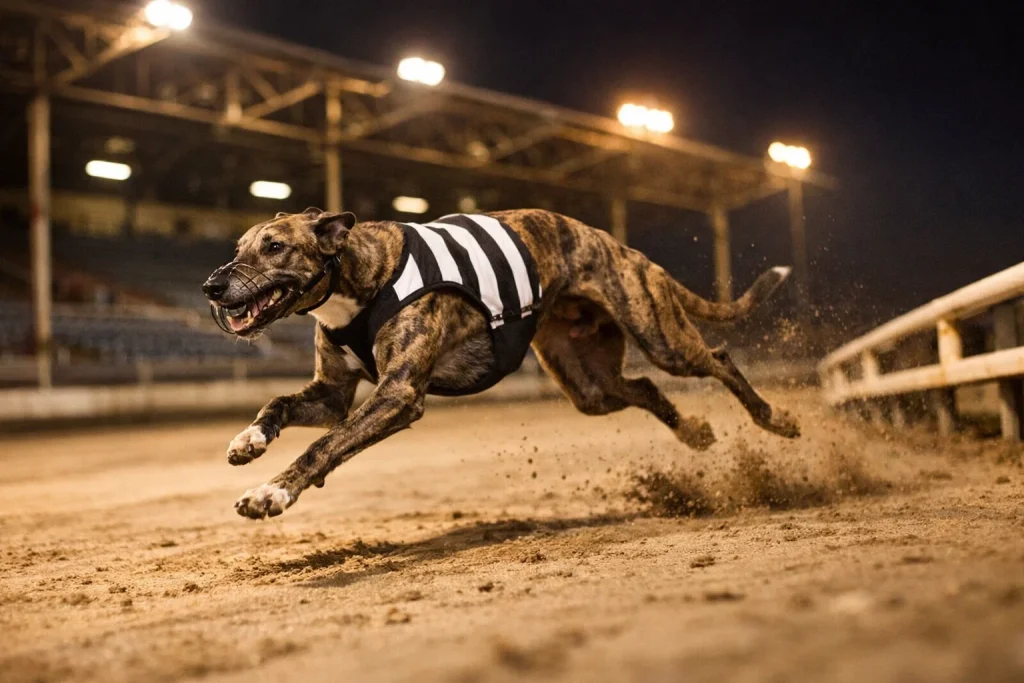
The night of 9 December 1986
There are evenings at a greyhound track that feel ordinary until they’re not. The 9th of December 1986 at Brighton & Hove Greyhound Stadium was one of them. Ballyregan Bob — a brindle dog trained by George Curtis, kennel-based at the track — stepped into the traps needing one more win to break the world record for consecutive victories in licensed greyhound racing. He’d already won 31 in a row. Nobody in the crowd was pretending it was a normal meeting.
The race itself was almost anticlimactic. Bob broke cleanly, established his racing line by the first bend, and won in a style that had become utterly familiar to anyone following the streak — controlled early pace, clean cornering, a final-straight acceleration that left the field behind without looking like it required maximum effort. Win number 32. World record. At Hove.
See also: hove greyhound results — your Hove greyhound racing centre.
The streak’s chronology, win by win
The 32-win streak didn’t start with fanfare. Ballyregan Bob’s early wins in the sequence were standard graded victories at Hove — well-executed races that drew modest attention because plenty of good dogs string together five, six, seven wins before hitting a field they can’t beat. The streak started attracting serious notice around win 15, when track regulars began to realise that Bob wasn’t just winning races — he was winning without being tested.
Brighton & Hove Stadium opened on 2 June 1928 and had seen outstanding dogs come through its kennels across six decades, but nobody in the stadium’s history had put together anything close to a run of this kind. The chronology has a rhythm: early wins at Hove across shorter distances, progression to the 515m trip where Bob’s balanced speed profile — fast enough to lead, strong enough to sustain — gave him an edge the opposition couldn’t close. Mid-streak, the competition intensified as racing managers and trainers attempted to assemble fields designed to challenge him. It didn’t work.
Wins 20 through 30 were where the streak crossed from impressive to historically significant. By that point, the national press had picked up the story, BBC television had committed to covering the record-breaking attempt, and the Hove crowd had swollen from regular numbers to something closer to the big-night attendance the stadium saw for category finals. Each win in that window had a quality that’s hard to replicate — the sense that every race could be the one where the streak ended, combined with the accumulating evidence that it wasn’t going to.
Win 31 was the pressure point. One short of the record. Curtis reportedly maintained his usual training routine — no special preparation, no altered feeding schedule, no public acknowledgement of the record beyond a quiet awareness that the dog was fit and ready. The race was run, won, and the record-attempt race was confirmed for the following meeting.
George Curtis’s training method
What George Curtis did with Ballyregan Bob was unusual, and it’s worth understanding because it tells you something about what kind of streak is possible in greyhound racing and what kind isn’t.
Curtis was a Hove-based trainer with a reputation for patient conditioning. His approach with Bob — as described by contemporaries and documented in the coverage of the streak — was built on consistency rather than peak performance. He didn’t wind the dog up for individual races. He kept Bob in a steady training rhythm that produced a reliable performance level across every meeting, which meant the dog arrived at each race fit but not over-trained, fresh but not under-worked.
The specific elements. Curtis managed Bob’s race frequency carefully — regular enough to keep the dog race-sharp, spaced enough to allow full recovery between outings. He was attentive to weight, diet and exercise in a way that was considered meticulous even by the standards of professional trainers at the time. And he chose Bob’s races strategically, entering him in fields where the competition was real but where the racing manager’s grading had produced a fair contest rather than a stacked one.
What Curtis didn’t do is equally revealing. He didn’t restrict Bob to one distance. He didn’t avoid difficult draws. He didn’t pull the dog from a race because the conditions were marginal. The streak was built on the premise that a well-conditioned dog in the hands of a disciplined trainer should be able to win on merit across a range of conditions — and that premise held for 32 consecutive races, which remains the most emphatic validation of training consistency the sport has ever produced.
What came after the record
Ballyregan Bob didn’t race forever. The streak ended, as all streaks do — a defeat that felt inevitable by the time it arrived, if only because the accumulated statistical improbability of winning indefinitely catches every runner eventually. The defeat didn’t diminish the record; it placed it. Thirty-two consecutive wins at licensed greyhound tracks, across varying fields, distances and conditions, had set a benchmark that nobody in the four decades since has matched.
After retirement, Bob’s story took a trajectory familiar in greyhound racing — rehoming, post-racing life, and a gradual transition from active competitor to historical figure. The dog lived out his retirement years and died in the early 1990s. Curtis continued training at Hove, though no subsequent runner from his kennel came close to the streak record.
What the record did for Hove. It attached the stadium’s name to the single most recognisable achievement in UK greyhound racing history. Any reference to Ballyregan Bob references Hove. Any discussion of consecutive-win records references the night of 9 December 1986 at Nevill Road. That association has a value that’s hard to quantify but easy to observe — Hove’s identity as a venue includes the Ballyregan Bob record in a way that other track records (fastest times, biggest prize funds) don’t quite match. Speed records get broken. The 32-win record hasn’t.
Legacy at Hove today
The Ballyregan Bob Memorial is a named race on the Hove card — a fixture that keeps the dog’s name in active circulation rather than relegating it to the history books. I’ve worked form on Memorial races for years, and the one constant is that the race draws a different kind of attention from the track’s regular card. Punters who weren’t alive in 1986 know the name. Trainers entering dogs in the Memorial treat it with a weight that exceeds the prize on offer, because winning a race named after the most famous dog in Hove’s history carries a meaning beyond money.
Read about the Olympic greyhound race at Hove.
The broader legacy. Ballyregan Bob’s streak demonstrated that UK greyhound racing, at its best, is capable of producing genuinely historic sporting performances — the kind that cross over from the niche into the national consciousness. The 1986 record was covered by the BBC, reported in the national press, and entered the cultural record of British sport in a way that routine greyhound racing doesn’t. That crossover moment hasn’t been repeated at Hove or anywhere else in the sport, which makes the record not just a benchmark but a high-water mark for greyhound racing’s public visibility.
For today’s form analyst, the practical relevance of the streak is in the training principles it validated. Curtis’s approach — patient conditioning, managed frequency, strategic race selection, absolute consistency — is still the template for trainers building winning sequences at Hove. No sequence since has approached 32, but the five-, six-, seven-win runs that top Hove trainers produce every season are built on the same fundamentals that Curtis applied. The Hove history and records overview places the Ballyregan Bob era within the broader timeline of the stadium’s 98-year story.
