
A Century of UK Greyhound Racing: Belle Vue 1926 to 2026
 Available in US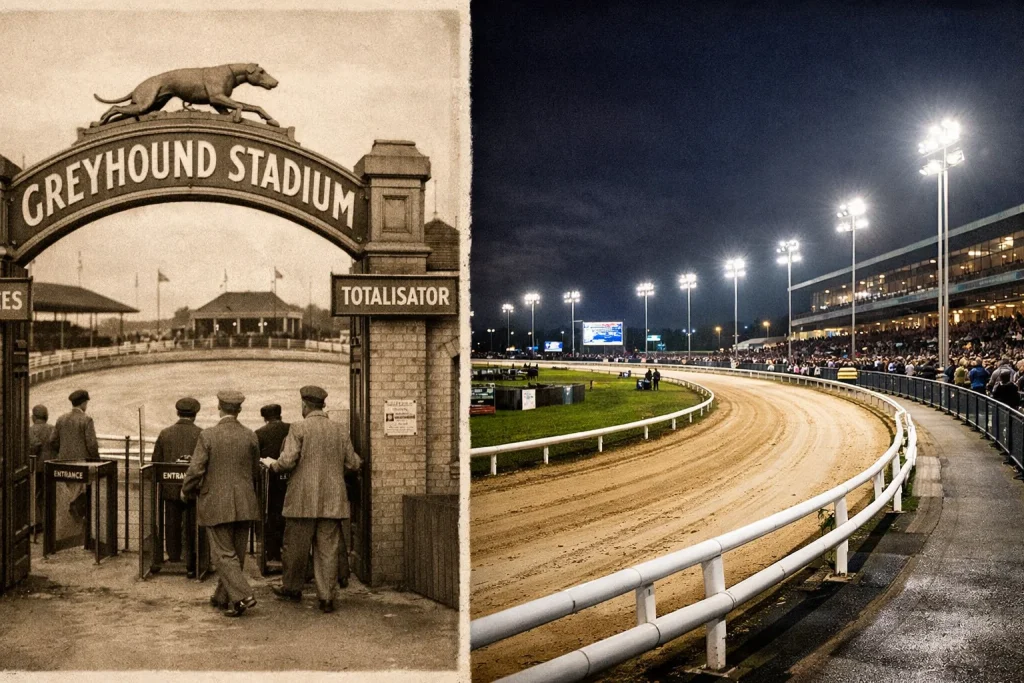
Belle Vue, 24 July 1926
A hundred years ago, on 24 July 1926, six greyhounds chased a mechanical hare around an oval track at Belle Vue in Manchester. It was the first licensed greyhound race in Britain, and nobody in the crowd could have known they were watching the birth of what would briefly become the country’s second-largest spectator sport. I think about that evening whenever I write up a Hove card — the line from Belle Vue 1926 to Brighton & Hove 2026 runs through a century of boom, bust, regulation, reinvention and, now, existential political pressure.
The Belle Vue meeting was an import. Greyhound racing with a mechanical lure had been developed in the United States, and a group of British entrepreneurs saw commercial potential in adapting the concept for a British audience accustomed to dog coursing (live-hare pursuit) and horse racing. The 1926 meeting was a proof of concept — would the British public pay to watch dogs chase a fake hare? The answer was emphatic. Belle Vue drew a large crowd, the betting market functioned, and within months new tracks were opening across England and Scotland at a rate that would, within two decades, produce the most concentrated period of greyhound-racing expansion anywhere in the world.
See also: hove greyhound results — all about Hove greyhound racing.
The 1940s peak: 75 million spectators, 77 tracks
The numbers from the peak era are hard to process against the current landscape. In 1946, greyhound racing in Britain attracted an estimated 75 million spectators. By January 1947, the sport was being staged at 77 licensed tracks — venues scattered across every major city and many smaller towns, serving a working-class audience for whom an evening at the dogs was as routine as a Saturday-afternoon football match.
Those figures need context. Seventy-five million admissions, not 75 million individual spectators — the same regular punters attended multiple times per week, inflating the headline number. But even with that adjustment, the attendance base was staggering. Greyhound racing’s post-war peak placed it behind only football in the hierarchy of British spectator sport, ahead of horse racing, cricket and rugby by a margin that today seems implausible.
What drove the peak. Three factors converged. First, greyhound racing was cheap — admission prices were set to attract working-class crowds, and the evening schedule (starting after the working day ended) made it accessible to people who couldn’t attend afternoon events. Second, betting was embedded in the experience — the tote and on-course bookmakers provided a gambling mechanism that was legal, regulated and physically convenient in a way that off-course horse betting (illegal until 1961) wasn’t. Third, post-war austerity created demand for affordable entertainment. The dogs offered an evening out, a social atmosphere, and a flutter, all for a few shillings.
From mass sport to niche: the long decline
The decline from 77 tracks to 18 GBGB-licensed stadiums in 2026 happened in phases, not in a single collapse. The first phase was television — the BBC and ITV offered free evening entertainment from the mid-1950s onward, directly competing with the greyhound stadium for the casual spectator’s time. The second was the 1961 Betting and Gaming Act, which legalised off-course betting shops and removed the greyhound track’s monopoly as a legal betting venue. The third was suburbanisation and land values — urban greyhound stadiums sat on real estate that became enormously valuable for housing and retail development, and owners sold.
Emma Slawinski, chief executive of the League Against Cruel Sports, has described greyhound racing as cruel from start to finish and has called for a ban in England to follow the Welsh and Scottish votes. That position represents the welfare-advocacy end of a spectrum that has gained political traction as the sport’s economic and cultural base has shrunk. A sport with 75 million annual admissions could absorb political opposition through sheer cultural weight. A sport with 18 stadiums and declining revenue cannot.
The number of online betting accounts in the UK grew from 17 million in 2014 to over 37 million in 2024 — a migration of betting activity from physical venues (shops and tracks) to screens that has fundamentally altered the economics of greyhound racing. The dogs still run, but the audience has moved. BAGS afternoon racing generates its revenue through SIS feeds to screens, not through turnstile admissions. The stadium as social venue — the 1940s model — has given way to the stadium as content factory, producing live racing for a remote market that never walks through the gate.
2026 centenary events: Dunstall Park 7 March
The centenary year is being marked, and the flagship event took place on 7 March 2026 at Dunstall Park — a combined horse-and-greyhound fixture that was designed to celebrate the sport’s hundred-year history by staging both disciplines at the same venue on the same day. The symbolism was deliberate: Dunstall Park’s dual-purpose facility (one of the few in the UK that hosts both horse and greyhound meetings) provided a visual argument that greyhound racing belongs in the mainstream of British racing culture, not on the margins.
The 7 March event drew attention from the trade press and generated coverage in the national media — partly for the centenary narrative and partly because the timing was dramatic. Ten days after the Dunstall Park celebration, Wales voted to ban greyhound racing. The day after that, Scotland did the same. The centenary celebration and the legislative assault happened in the same month, which gave the hundredth birthday of British greyhound racing a bittersweet quality that nobody involved in organising the Dunstall Park event had anticipated.
Other centenary-related activity across 2026 has included historical retrospectives in the specialist press, archive exhibitions at several tracks, and increased GBGB engagement with the heritage dimension of the sport — a recognition that the centenary year is an opportunity to tell the sport’s story to an audience that knows it primarily through welfare headlines rather than through the racing itself.
Where Hove fits in the 100-year line
Brighton & Hove Greyhound Stadium opened on 2 June 1928 — two years after Belle Vue, which makes it one of the earliest greyhound venues still in continuous operation. The stadium’s own centenary is approaching in 2028, and the coincidence of the national centenary (2026) and the Hove centenary (2028) places the stadium at the centre of two overlapping heritage narratives.
Explore the history and records at Hove greyhounds.
Hove’s position in the hundred-year line is distinctive. It isn’t the oldest surviving track — others predate it by months — but it’s one of the few that has operated continuously from the late 1920s through to the present without a significant closure or relocation. The Nevill Road site has been a greyhound stadium for nearly a century, and the racing that takes place there today — five meetings a week, category races, a full A1-to-A9 grading ladder — is a direct descendant of the racing staged on the same circuit in 1928.
The centenary context matters for Hove because it highlights both durability and fragility. Durability: Hove has survived two world wars, the 1950s-onwards attendance decline, the 1987 surface change, the post-2000 stadium closures that eliminated dozens of UK tracks, and the political pressure that culminated in the 2026 bans in Wales and Scotland. Fragility: the stadium operates in a jurisdiction — England — that is now the last remaining part of the UK where commercial greyhound racing is legal, and the political trajectory of the other two nations suggests that English tracks are operating on borrowed political goodwill. The centenary year is a celebration, but it’s also a reckoning. The next hundred years are not guaranteed in the way the last hundred unfolded.
The complete Hove track guide covers the stadium’s history, form archive, welfare data and legislative context — the full picture of a venue that has been producing greyhound racing results for nearly as long as the sport has existed in Britain.
