
The 285m Sprint at Hove: Brighton & Hove's Flying-Start Distance
 Available in US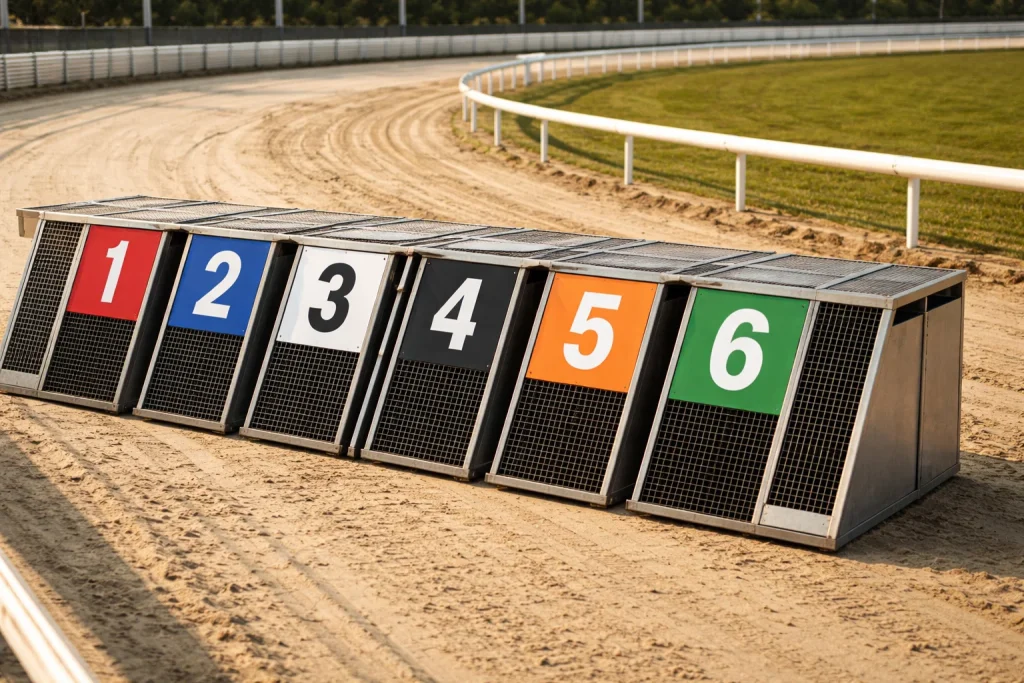
The shortest trip at Hove
The 285m at Hove is over before most punters have finished shouting. I timed my first live 285m race by instinct — it felt like five seconds from the traps opening to the first dog crossing the line, and the official time wasn’t much longer. That compression is the entire point of the distance: everything that happens in a 515m race over two bends and a home straight happens here in a single burst from box to finish.
At 285m, Hove is running its shortest available distance — the bottom of a portfolio that stretches through 475m, 515m, 695m, 740m, 930m and 970m. The Hove track has a 455-metre circumference, which means 285m is significantly less than a full circuit. The dogs break from the traps, reach the first bend and arrive at the finish in a compressed sequence that strips out everything except raw speed and trap draw. There’s no second bend, no sustained-pace assessment, no finishing kick to evaluate. The 285m is a break-speed competition, and the dog that wins is almost always the dog that got to the front first.
See also: hove greyhound results — your Hove greyhound racing centre.
Start position and run-up to first bend
The 285m start at Hove positions the traps in a location that gives the field a run-up to the first bend and then a short stretch around the turn to the finish. That geometry — short run-up, one bend, short finish — determines the entire racing dynamic.
What the start position does. It compresses the decision point to the first three seconds of the race. A dog that breaks slowly from the box at 515m has 80 metres to recover before the first bend; a dog that breaks slowly at 285m has functionally no time to recover. By the time a slow breaker has reached racing speed, the fast breakers are already established on their cornering line and the race is structured. At 515m, a slow break is a disadvantage. At 285m, a slow break is a near-certain defeat.
The run-up distance from traps to first bend on the 285m is shorter than on any other Hove distance, which means the dogs cover less ground before the field compresses into the turn. On a 455-metre circumference, the bend itself is tight relative to the dogs’ speed — they’re arriving at the turn before they’ve fully decelerated from the initial sprint, which produces a different cornering dynamic from the 515m where dogs have more time to set their line before entering the bend.
Break speed as the decisive factor
There’s a saying at the Hove rail that the 285m is “won in the box.” It’s not quite true — the cornering still matters — but it’s closer to true than at any other distance on the card. Break speed at 285m is the single most important performance variable, and the form reader who understands that will read a 285m card differently from every other race on the meeting.
How to read break speed from the form. The sectional column — the split time to the first timing point — is the diagnostic at 285m. A dog with consistently field-leading sectionals at this distance is a genuine sprint specialist: its neuromuscular response to the traps opening is faster than the average, and that advantage converts directly into a positional lead before the field reaches the bend. Two-tenths of a second advantage at the first sectional point on a 285m race is the equivalent of a length or more on the track, and that margin is almost impossible to close over the remaining distance.
What break speed doesn’t tell you. It doesn’t tell you how the dog handles the bend. A dog with an explosive break but poor cornering technique can reach the turn in front and then lose position as the field closes through the corner. This is the 285m’s distinctive tactical trap: the fastest breaker doesn’t always win, because the bend demands a different skill — deceleration control, line selection, balance — that isn’t measured by the sectional split. The best 285m dogs combine fast breaks with clean bends. The form reader who weights break speed exclusively at 285m will find occasional losers who looked like certainties.
Trap draw impact on 285m
Trap draw at Hove 285m carries more weight than at any other distance on the card, and the weight falls unevenly. The inside traps — 1 and 2 — have the shortest route to the bend and through it. The outside traps — 5 and 6 — have the longest route and the widest angle. At 515m, a wide-running dog drawn 6 can compensate by sweeping the outside line through two bends. At 285m, there’s only one bend and the compensation time doesn’t exist.
Trap 1 at 285m is the most advantaged draw on the entire Hove card at any distance. A genuine rail-runner with a fast break drawn inside at 285m has the shortest route from box to finish and the cleanest line through the only bend. The statistical advantage isn’t subtle — it’s visible in the win percentages over any sustained period. Trap 6 at 285m is correspondingly the hardest draw: a dog drawn outside has to cover more ground, arrive at the bend from a wider angle, and find its line while the inside dogs are already established on the rail.
The grading interaction. At lower grades — A6, A7, A8 — the trap-draw effect at 285m is amplified because lower-grade dogs handle non-preferred draws less competently. A railer drawn 5 in an A7 285m race is a near-certain loser; the same dog drawn 1 is a genuine chance. At A1 and A2, the top-grade dogs have refined their technique to the point where a non-preferred draw is a disadvantage rather than a disqualification, but even at the top of the grading ladder, 285m trap statistics favour the inside.
Dogs that specialise at 285m
Sprint specialism in greyhound racing is a real thing, and it produces a distinctive profile that the form reader should recognise. A 285m specialist at Hove is typically a dog with explosive break speed, a compact build that suits the tight Hove cornering geometry, and a form line dominated by short-distance entries. These dogs are fast but not necessarily stamina-rich — their career form at 515m might show mid-pack finishes because the longer distance exposes a pacing flaw that the 285m masks.
Explore Hove marathon distances: 740m, 930m and 970m.
How to spot one on the card. Look for dogs whose recent runs are clustered at 285m and 475m, with a preference for the shorter trip shown by better finishing positions and faster relative sectionals at 285m. A dog that wins at 285m but fades at 475m is a specialist. A dog that wins at both is a versatile sprinter with broader form value. The distinction matters for grading — a sprint specialist promoted to a higher grade based on 285m form may struggle when the racing manager cards them at 515m, where the race demands skills the dog hasn’t demonstrated.
The Hove 515m track record of 29.30 seconds, set by Barnfield on Air in 2007, is the benchmark that dominates form discussion at the track, but the 285m has its own speed ceiling — a record that reflects pure break-and-bend performance without the second-half pacing that the 515m requires. The two records measure different things: the 515m measures complete racing ability, the 285m measures explosive speed. Both are part of Hove’s seven-distance portfolio, and both appear on the same weekly card. The complete Hove track guide maps all seven distances and how they interact.
