
Hove Greyhound Grading: The A1 to A9 Ladder Explained
 Available in US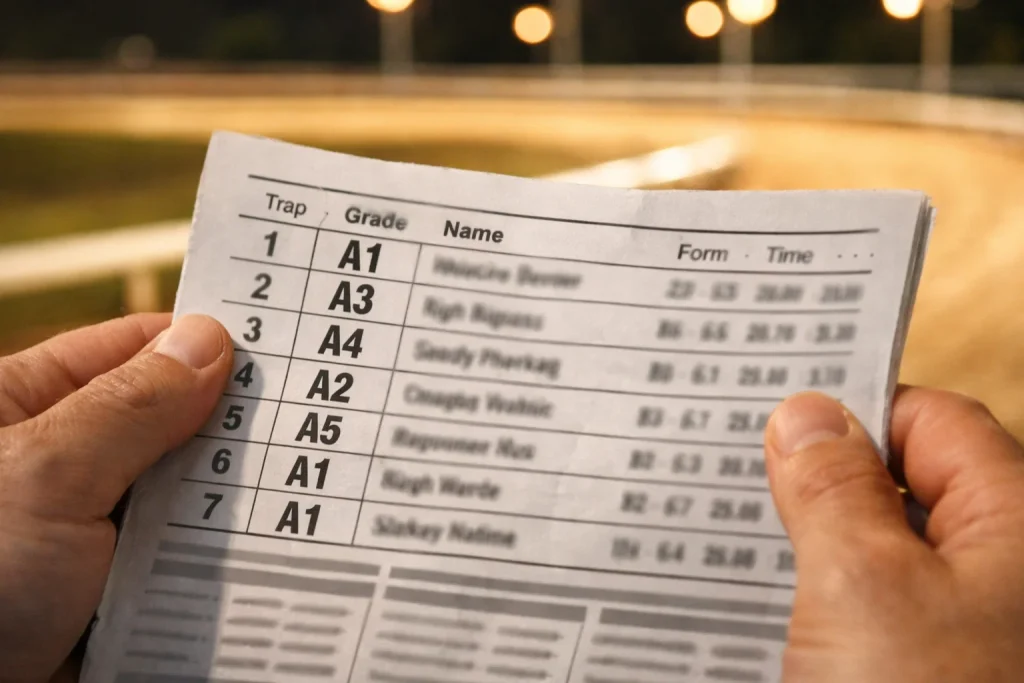
The A-grade ladder at Hove
I once asked a first-time visitor to Hove what the “A3” on the racecard meant. He guessed it was a road classification. It’s not, but the comparison isn’t as far off as it sounds — grading at Hove is a classification system, and where a dog sits on it tells you more about their likely race performance than any other single column on the card.
Hove’s open-class races run on an A-grade ladder from A1 at the top to A9 at the bottom. Every active racing greyhound at the stadium is slotted onto a rung based on recent racing time. The grade dictates which races the dog can enter, who they run against, and — critically — the expected time window for a competitive performance at that level. With approximately 6,000 greyhounds registered annually for racing across the UK and roughly 500 licensed trainers managing them, the grading system is the structural mechanism that keeps competitive fields balanced from the best nights down to the quietest afternoon cards.
See also: hove greyhound results — your Hove greyhound resource.
A1 at the top: what earns the grade
There’s a moment in a dog’s career when it moves into A1 and you can feel the shift on the card. The race distances tighten, the finishing times cluster, and the margin between winning and losing compresses from lengths to tenths. A1 is the top rung of Hove’s open-grade ladder, reserved for dogs whose recent race times at the stadium fall within the fastest band set by the racing manager.
How a dog gets there. The grading system at GBGB-licensed tracks uses a time-based calculation anchored to the distance and surface. A dog running consistent 515m times in the sub-29.70 bracket at Hove, for example, is operating at a level that lifts them into A1 territory. The exact thresholds are set locally by the racing manager based on the running stock at the track and adjusted periodically to keep the grade populated — an A1 race needs a full card, not just one outstanding dog.
What to read on a Hove card when you see A1. The form column is doing less work than it does at lower grades, because every dog in the race has proven they belong at the level. Trap draw, sectional time and running-style become the dominant form reads. The grade is the qualifier; everything else is the decider. I’ve seen A1 races at Hove 515m where all six dogs had winning times within two-tenths of each other, and the race was won by the dog with the cleanest trap draw and the fastest first split — form factors that wouldn’t have mattered at A6, where time variation gives you a much easier sorting job.
Moving up: consecutive wins and grade promotion
A dog that wins at A4 doesn’t stay at A4. The Hove racing manager reviews recent runs and applies time-based adjustments that push a winning or fast-improving dog upward. The informal rule of thumb — and it varies by track and by period — is that a dog winning by clear margins or recording times materially better than its current grade will be promoted one or two rungs within a few meetings.
The nuance that catches out casual readers. Grade promotion isn’t triggered only by wins. A dog that finishes second with a faster time than the winner’s previous best can still move up. Timing drives the system, not just finishing position. I’ve watched trainers at Hove manage a dog’s career arc by timing runs against the grade threshold — deliberately not breaking records on a quiet Wednesday afternoon to keep the dog at a grade where it’s competitive rather than earning promotion into a level where the competition is materially tougher.
What a fresh grade-up looks like on the card. The dog will appear at a new rung — A4 to A3, say — with a form line that includes recent wins or fast seconds at the lower level. This is a red flag in both directions for form analysis. The dog may be genuine A3 quality and ready to compete. Or the dog may have peaked at A4 and been promoted beyond its ceiling. The next two runs at the higher grade answer the question. If the sectional and finishing times hold, the promotion was earned. If the times fall off, expect a grade drop within a few meetings.
Moving down: failing to place and grade drop
Grade drop at Hove is where grading stops being a neutral classification and starts carrying weight. A dog that runs consistently slower than its grade peers — finishing behind the field, recording times outside the expected band — will be moved down the ladder. That process is routine, mechanical and unsentimental.
The form-analyst’s view. A grade drop is not always bad news. A dog that was struggling at A3 and drops to A4 may suddenly have competitive times again because the field has softened. I look for the gap between the dog’s recent average and the new grade’s average: if the gap is positive (dog is faster than the new grade), the drop is a buying signal. If the dog is still slow relative to the new peers, the decline is structural and the drop won’t help.
Historically, the bottom of the grading ladder had bleaker implications. Dogs that could no longer compete at any race-worthy level sometimes faced economic euthanasia — being put down because no racing or rehoming pathway existed. That trajectory has changed dramatically. As GBGB chief executive Mark Bird stated, economic euthanasia has been reduced by 98% since 2018, from 175 cases to just three in 2024. The grading system’s bottom rungs now connect to retirement and rehoming pathways rather than to a dead end, which is a structural change in what a grade drop means for a dog’s life, not just its racing career.
A9 at the bottom: maiden and qualifier context
A9 at Hove is the lowest open-grade rung, and it serves a specific purpose — it’s where maiden greyhounds (dogs that haven’t won a race) and new arrivals at the track begin their graded career. The dogs here are not necessarily slow. They’re often untested at the venue, or recovering from a break, or transitioning from another GBGB track where they raced under different conditions.
What I look for in A9 form at Hove. The finishing time is less predictive than the trajectory. A dog with three runs at A9 and improving times each time is being prepared for promotion. A dog with five runs at A9 and flat or declining times is at its level. The sectional column matters here more than at higher grades because A9 fields often include dogs with unrefined break technique — the first split separates the genuine prospects from the rest.
Qualifier races, which sit outside the A-grade ladder entirely, serve a similar filtering function. A dog qualifying at Hove runs a time trial or a low-stakes race that gives the racing manager enough data to slot them into the correct grade. Once the qualification time is recorded, the dog enters the ladder at the rung matching that performance. I’ve seen dogs qualify at Hove and enter straight at A4 — it’s about the time, not about starting at the bottom.
Grading vs Category 1 stakes races
One distinction that regularly confuses visitors to Hove cards: the A-grade ladder and the Category system are not the same thing. Grading (A1-A9) applies to open races — the bread-and-butter cards that make up the majority of Hove’s five weekly meetings. Category status (Category 1, Category 2, Category 3) applies to named stakes races — the Coral Regency, Sussex Cup, Brighton Belle, Olympic — where entry is by invitation or qualification, and where the grade ladder is temporarily irrelevant.
Explore Hove Category One races.
A dog can be graded A2 on its weekly open-race card and still enter a Category 1 stakes race. The Cat-1 entry criteria involve trainer nomination, qualifying-round performance and sometimes an invitation from the racing manager based on recent form — not the dog’s rung on the A-grade ladder. This is why you sometimes see a dog winning a Category 1 race who isn’t the top-graded dog at the track. The two systems measure different things: grading measures weekly consistency against local peers; category status measures peak performance in the sport’s headline fixtures.
For the form analyst, the practical takeaway is this. Don’t read an A2 grading as equivalent to being “the second-best dog at Hove.” Grading is a time-classification tool, not a ranking. And don’t assume a Category 1 winner will dominate the following week’s A1 race — the competition frame is different, the field composition is different, and the racing conditions are not comparable. The complete Hove track guide sets the two systems side by side if you want the broader view.
